March 12, 2026
Layers of Brilliance - Episode Six: Vanishing Act


March 12, 2026
Layers of Brilliance - Episode Six: Vanishing Act
We trace the final chapter of Katharine’s career, her retirement from GE, and her disappearance from public memory.
Episode Description
How is a legacy preserved, and how is someone forgotten? Determined to make a final name for himself, Irving Langmuir ventures into science that even he might classify as pathological wishful thinking, while Katharine continues her work as the diligent experimenter. But her contributions faded from both the company’s and the public’s memory.
We go to visit her, to say good-bye – and we look at the wisdom she imparted to the next generation of inquiring minds.


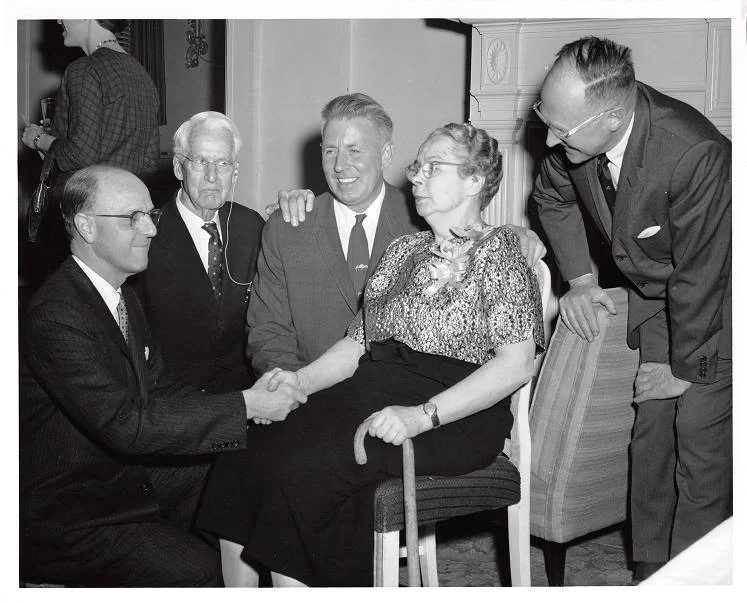

Katie is co-founder and co-executive producer of The Lost Women of Science Initiative. She is the author of six nonfiction books and one novel, and was a longtime reporter for The New York Times. She is at work on her second novel.

Natalia is a Peruvian journalist, editor, and writer based in Philadelphia. Her work focuses on gender inequality, labor issues, and reproductive rights. Natalia has worked as an editor for Radio Ambulante at NPR and in 2021, she won the Aura Estrada International Literary Award. She is currently working on her first book.

Sophia Levin is a journalist and teacher based in Washington, D.C. and Pittsburgh, PA. She has written about unions, infrastructure, and reproductive healthcare for The Tartan and PublicSource. She holds a bachelor’s degree in Creative Writing and History from Carnegie Mellon University.

Hannah is a Boston-based journalist with a background in storytelling, production, and strategic communication. She has reported on a variety of topics, including arts, culture, finance, and relationships between municipal agencies and communities. She studied journalism and art history at Northeastern University.
Katie is co-founder and co-executive producer of The Lost Women of Science Initiative. She is the author of six nonfiction books and one novel, and was a longtime reporter for The New York Times. She is at work on her second novel.
Natalia is a Peruvian journalist, editor, and writer based in Philadelphia. Her work focuses on gender inequality, labor issues, and reproductive rights. Natalia has worked as an editor for Radio Ambulante at NPR and in 2021, she won the Aura Estrada International Literary Award. She is currently working on her first book.
Sophia Levin is a journalist and teacher based in Washington, D.C. and Pittsburgh, PA. She has written about unions, infrastructure, and reproductive healthcare for The Tartan and PublicSource. She holds a bachelor’s degree in Creative Writing and History from Carnegie Mellon University.
Hannah is a Boston-based journalist with a background in storytelling, production, and strategic communication. She has reported on a variety of topics, including arts, culture, finance, and relationships between municipal agencies and communities. She studied journalism and art history at Northeastern University.
George Wise is a former communications specialist at the GE Research and Development Center in Schenectady. He is also a historian of science and technology, and the author of The Old GE (2024).
Ginger Strand is an American author of nonfiction and fiction. She is the author of the 2015 nonfiction book, The Brothers Vonnegut: Science and Fiction in the House of Magic.
David Kaiser is a professor of physics and the history of science at the Massachusetts Institute of Technology.
Marijke Alkema is Katharine Burr Blodgett’s great niece.
Gary McCarthy has served as Mayor of Schenectady since April 2011. He co-chairs the Center for Economic Growth’s Capital Region Local Government Council, and previously served as President of the New York State Conference of Mayors.
Meg L. Winslow is Senior Curator of Historical Collections & Archives at Mount Auburn Cemetery in Cambridge, Massachusetts. Meg is co-author with Melissa Banta of The Art of Commemoration and America’s First Rural Cemetery: Mount Auburn’s Significant Monument Collection.”


Further Reading:
The Brothers Vonnegut: Science and Fiction in the House of Magic, by Ginger Strand, Farrar, Straus and Giroux, 2015.
Fixing the Sky: The Checkered History of Weather and Climate Control by James Rodger Fleming, Columbia University Press, 2012.
American Women of Science, by Edna Yost, Frederick A. Stokes Co, 1943.
The Old GE 1886-1986, by George Wise, Schenectady Historical Society, 2024.
The Lively Place: Mount Auburn, America's First Garden Cemetery, and Its Revolutionary and Literary Residents, by Stephen Kendrick, Beacon Press, 2016
Episode Transcript
Episode 6 - Vanishing Act
Announcer: Friends, they said it's a man's world, but don't you believe it. It's a woman's world too. Women are not only doing a fine job in the home , They're also making substantial contributions to scientific work in the General Electric Research Laboratory. At Schenectady, you will find many women scientists doing interesting and important work.
This is Dr. Katharine Blodgett, an authority on the properties of very thin coatings and films. Her work in this field has made her famous among scientists throughout the world.
Katie Hafner: In a promotional film from 1954, Katharine Blodgett is shown working on semiconductors, the cornerstone of the new field of electronics. She's now 56 years old, her big breakthrough, the discovery of non-reflecting glass, nearly 20 years behind her. She’s still respected and celebrated. In 1951, for instance, she was honored by the American Chemical Society for her work in surface chemistry. But as that decade wore on, she gradually dropped away. And today, ask most anyone, even those who live in Schenectady, if the name Katharine Burr Blodgett rings a bell, and this is what you hear.
Misc Voices: That is a name I have never heard before. I don't know who that was. Didn't she swim the Suez Canal? Oh wait, no, that was somebody else. No. Sounds familiar. I don’t know. Oh, remind me. What was her background? She was Dr. Blodgett's wife.
Katie Hafner: I'm Katie Hafner and this is Lost Women of Science.
Today, the final episode of Layers of Brilliance, the chemical genius of Katharine Burr Blodgett. We're calling this episode Vanishing Act.
What lasts? What disappears? And who decides? Because forgetting isn’t an accident. It’s a process.
So how did the world come to forget Katharine Burr Blodgett?
And what of her boss, Irving Langmuir? What happens when a scientist flies too close to the sun… or, in this case, to the clouds?
I went to Schenectady last summer, and one of the first things I did was look for the house Katharine lived in for more than 50 years, at 18 North Church Street in the city’s historic Stockade District.
Diagonally across from Katharine’s, I could see the house on Front Street, where Katharine was born, and where her father was murdered in 1897.
I was delighted to see a plaque on Katharine’s old house. How nice of the city to honor her with a plaque! But … not so fast. When I got close enough to read the plaque, my delight dissolved. The name on the plaque at 18 North Church Street is Benjamin van Vleck, who, according to the plaque, lived there in 1735. This Benjamin was part of one of the early Dutch families to settle in Schenectady in the 18th century.
Now even Katharine’s old house is tipping its hat to someone else. So what happened?
After her 1938 discovery of non-reflecting glass, Katharine had become one of the General Electric Company’s most celebrated scientists.
She was invited to give talks and asked to sit for interviews. Several colleges and universities awarded her an honorary degree.
Although her non-reflecting films were never commercialized – they were too soft and were wiped off too easily for use in actual products – GE did successfully commercialize one piece of her research: The color-gauge Katharine created to track film thickness. It did this by matching the color a thin film reflected to the number of layers it contained.
Following her most intense period of celebrity in 1939, courtesy of the exuberant GE PR machine, Katharine returned to her science, and in the never-a-dull-moment department, science with Irving Langmuir.
George Wise: There was a team that had gotten together at the lab, the key participants were Langmuir, Schaefer, Katharine Blodgett…
That's George Wise, the historian we've been hearing from this season.
George Wise: ...And a fourth person named Bernard Vonnegut, who was a physicist from MIT, best known today for bringing his brother Kurt to Schenectady to work as a publicity writer.
Katie Hafner: That would be Kurt Vonnegut, who, I mentioned earlier on in the season, went on to become one of the most famous novelists of the 20th century and who got a lot of material for his fiction directly from his experience at GE.
So Bernard Vonnegut, Irving Langmuir, Vincent Schaefer and Katharine Blodgett....
George Wise: During World War II, they worked on smoke screens for, um, the troops.
Katie Hafner: That is, a high-efficiency smoke generator that produced massive, persistent screens to hide troops and ships from enemy view. The GE team discovered that boiling oil under specific pressure through a calibrated nozzle created an ideal white fog of uniform light-scattering particles.
Langmuir, Schafer, and Blodgett, along with other members of the team, carried out some of the experiments that led to that discovery.
In the spring of 1942, the team began testing its smoke generator, trying to determine how many gallons of oil had to be vaporized to create a smoke screen wide enough and dense enough to block visibility across miles. That was what the armed forces needed.
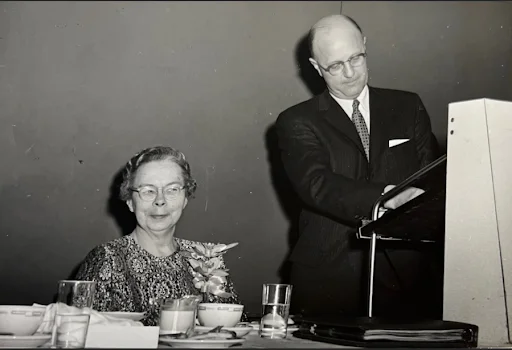
Katharine later recalled that period at her 1963 retirement dinner. She explained that the tests couldn't be made in the laboratory— They needed to be done under field conditions. They …
Katharine Burr Blodgett: Needed a place where the air would be quiet and smoke would spread out for a long distance.
Katie Hafner: The tests were carried out in the Schoharie Valley, southwest of Schenectady.
Katharine Burr Blodgett: The program was, we leave Schenectady at 3:30 in the morning and drive to the Schoharie Valley. Well, that was alright. My job was to be ready at 3:30 when the boys came for me with several quarts of hot coffee and thermos bottles and a big pile of sandwiches.
Katie Hafner: Did she just say she was assigned lunch? Ok… but that wasn’t all Katharine did.
Once they arrived, Vince and Irving would climb Vroman's nose, a hill that rises sharply from the valley floor. They brought cameras with them and observed the smoke from above.
Katharine stayed down in the valley. Her job was to operate the radio and relay information between the men on the hill and the team running the smoke generator below. And if the radio failed -as it often did- she was the backup system. Her instructions were simple: if she couldn’t reach them by radio,
Katharine Burr Blodgett: Just yell! [laughs]
Katie Hafner: Just yell.
They ran the experiments all morning, and then they’d have a picnic. Katharine loved that field work.
Katharine Burr Blodgett: It was a great anticlimax when we had to pick up at noon and go back to Schenectady to the laboratory.
Katie Hafner: The work paid off in a huge way.
Before the GE team began that smoke screen research, the army’s best attempts at a smoke screen were created by smoke pots. Those only obscured small areas, and required many people to operate, plus they had to be tended to almost every hour to keep them producing the smoke. And during the day, they were barely effective. Plus, once the smoke was released, it irritated the noses and throats of the people it was supposed to protect.
The GE research team addressed these challenges. Their smoke screens covered many square miles and needed fewer people to operate them. In addition, the smoke produced was less toxic, so it didn’t irritate the troops.
In June 1944, on D-Day, the Allied forces deployed massive vertical "smoke curtains" to shield the invasion fleet from the German batteries that lined the coast.
For Irving Langmuir, this work manipulating the air would inspire him and the team to focus on the strangest darn science they would ever do.
“Everyone complains about the weather, but nobody does anything about it.” That's the great line from the writer Charles Dudley Warner that his famous friend Mark Twain liked to quote. But what does that have to do with Irving Langmuir?
The smokescreen project, says George Wise…
George Wise: Kind morphed over into, um, working on the atmosphere and particles in the atmosphere in general. One of which was what makes it rain or snow.
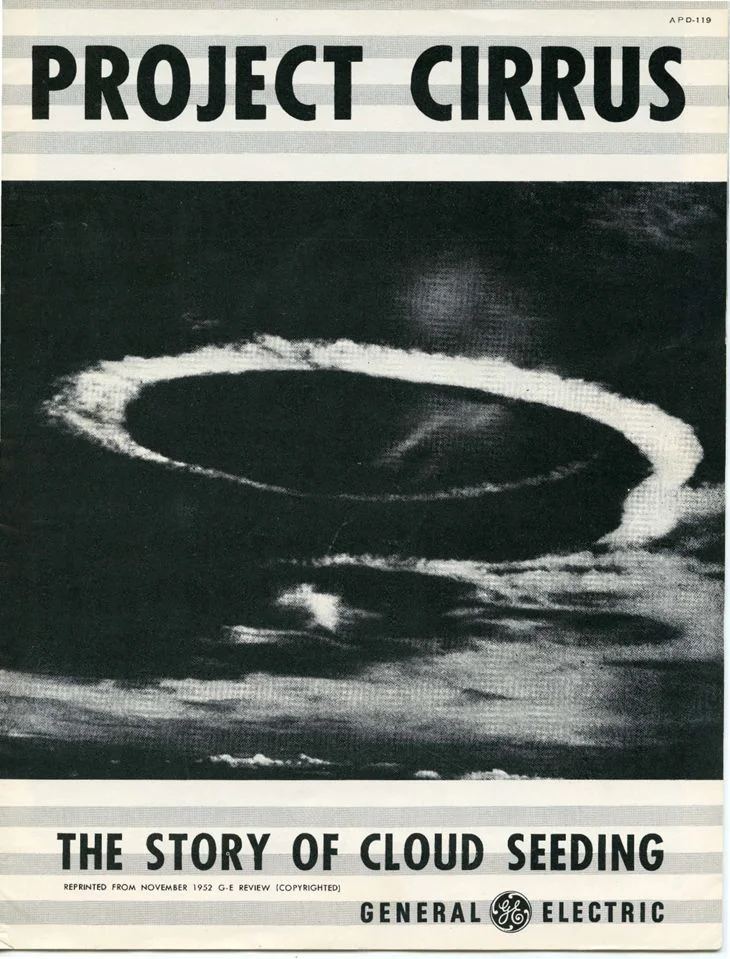
This was the start of what became known as the cloud seeding project. An attempt to control and even promote precipitation— a science that could have wide implications if it was proven to be possible.
Vincent Shaefer was leading the experiments. In a speech years later, Katharine recalled the day a piece of equipment he had requested was delivered to the lab room they shared:
(GE refrigerators and freezers AD): They’ve got features to talk about, features to remember. General Electric refrigerators and freezers…
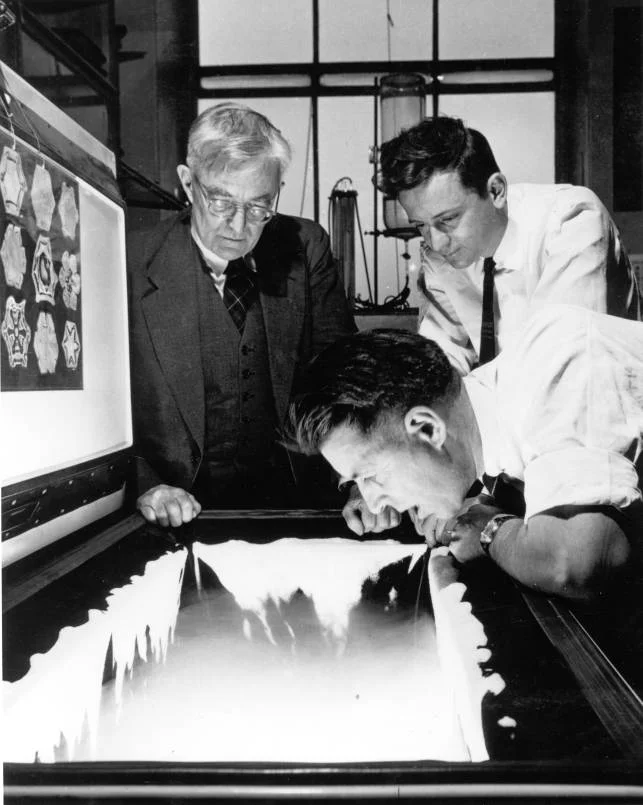
Katie Hafner: Yes, a lidded food freezer, the kind you put in your garage and use for storing frozen sides of beef. Vincent then lined it with black velvet so he could see if ice crystals were forming. Then, he blew a big, long exhale into the freezer and watched his breath hang, creating a super-cooled cloud, right there in that portable freezer. The next question: what could be added to form ice crystals?
The answer arrived by accident. One hot summer day, to keep the temperature of the freezer down, Schaefer dumped a bunch of dry ice in, and millions of tiny ice crystals formed on the black velvet lining.
The tiny ice crystals were teeny tiny snowflakes, about three thousandths of an inch in diameter, or a fiftieth the size of fully grown snowflakes.
Then the question was this: Could this experiment to create snow work outside the lab… up in the clouds?
On November 13, 1946, Schaefer got in a small airplane with an unusual carry-on: six pounds of dry ice. As the plane flew over a thick cloud drifting leisurely over the border between New York and Massachusetts, Schaefer dropped all six pounds of the dry ice particles into it. The cloud began contorting as if it was in pain. Within five minutes, the entire cloud had become snow. Though the snow evaporated before hitting the ground, from Langmuir’s view in a Schenectady control tower and Schaeffer’s view in the sky, they had witnessed true wonder: they had broken down a cloud. They had created the first artificial snowstorm.
The researchers wondered if, instead of using dry ice, there was a chemical they could use to create those ice crystals.
Next came an epiphany from Vonnegut. Using silver iodide might do the trick.
Alas, the big bosses at GE weren't quite as keen on this cloud seeding adventure as Irving and Schaefer and Vonnegut were. As George Wise points out, this was a far cry from the safe pursuits of efficient lightbulbs and nifty multilayer films. These men were talking about controlling the weather.
George Wise: GE immediately realized that if they carried it out on their own, they would likely cause or be believed to have caused a terrible snowstorm or even some terrible thing. So they quickly turned it over to the government.
Katie Hafner: The company worried that an artificial snowstorm could cause accidents on the roads and that GE would be held responsible. Eager to create a safe legal distance between itself and the project, GE opened all its patents for public use and waived royalty rights.
The government took over and the experiment in cloud seeding got named Project Cirrus. While GE funded most of the work, the U.S. Air Force – which was then called the Army Air Forces – along with the Navy, provided aircraft.
George Wise: And the government was quite intrigued by this thing because it was potentially a weapon.
And they did a number of experiments, uh, of various kinds. The most controversial was that they decided that they might be able to, uh. Cause a hurricane to stop being a hurricane.
Katie Hafner: That experiment didn’t go according to plan. Instead of stopping, the hurricane changed course and blew out over land, upsetting a number of people and creating a great deal of damage.
But was it really Langmuir and his team who diverted the hurricane? Here’s the author Ginger Strand, who wrote about the cloud seeding experiments.
Ginger Strand: Given how much energy is in a hurricane, it would take a lot more than some, you know, little cloud seeding event to tip it in one direction or another. But, Irving was eager to claim, you know, success for the experiment.
Irving Langmuir: Nobody has ever wanted to repeat that experiment since then, but I think it should be done again.
Katie Hafner: That was Langmuir himself, describing the rogue hurricane to an audience after that happened – and playing it for laughs.
And what was Katharine doing during this big distraction? Wisely, she stayed mostly on the sidelines.
Ginger Strand: It's almost representative of the type of person that she probably was…
That’s Ginger again.
Ginger Strand: Because she's kind of always in the room.
Katie Hafner: In the room but not truly involved. Because Katharine made it clear she thought there were better ways these men could be spending their time.
As Katharine herself once described it, one afternoon when she was picking up her things to go home at 5:30 P.M, she and Barney Vonnegut (others called him Bernie but she called him Barney) were the only ones left. And she sang out, "Time to go home, Barney."
Ginger Strand: And these guys are doing this crazy stuff and they're like, oh, we're gonna seed the clouds and make it rain.
They got dressed up in their outfits and got on the bomber planes and pretended they were like, you know, World War II Aces and flew around throwing dry ice and silver iodide at the clouds and stuff. And Katharine’s there in the lab doing her experiments. And she's kind of like Bernie, you should probably go home to your wife.
Katie Hafner: Katharine opted out of the cosplay, but she wanted to help if she could and she did something quite remarkable.
GE ad: The new differential analyzer to be employed in solving involved mathematical problems. It can handle in two weeks work that would require a skilled mathematician 17 years to complete.
Katie Hafner: Years earlier, Blodgett and Langmuir had used that very computer to establish the trajectories of fine particles in the vicinity of fibers for the work they were doing on filters. Now, Katharine’s computer skills were needed again.
Here’s Vincent Schaefer.
Vincent Schaefer: Langmuir had the idea that he wanted to find out the trajectories of cloud droplets passing objects.
Katie Hafner: He got Katharine on the job. and the trajectories she calculated remain of basic importance in the physics of precipitation and the field of aircraft de-icing. De-icing, by the way, was another of Katharine’s areas of investigation during World War II.
Vincent Schaefer: I'll never forget the admiration I had for Katie. The results of that research that she did is still being referred to in most of the publications related to cloud physics today, it was really pioneering work.
Katie Hafner: All of this raised a question. And I asked it of Ginger Strand, did cloud seeding actually work?
Ginger Strand: You know, I had to basically get a tiny master's degree in cloud physics working on this project. But as far as I understand it, and talking to some of the smartest people who think about these things, it seems to me that it does work, but it does not work in the way that people in the general public think it works. It doesn't bring down rain from an empty sky. It doesn't steal rain from one location that would've landed at another. What it does is it just… a cloud is, is not just a big reservoir of water up there. It's a whole bunch of chemical and physical processes happening up in the sky, and cloud seeding just makes those processes a little more efficient. It helps the clouds kind of make more rain and drop more rain, increasing the productivity of clouds by about five percent. Five, I think it was five to10, or five to eight percent. So that's like, oh, well, big deal. That's not gonna make the desert bloom.
Katie Hafner: And yet, what we are witnessing here is a man obsessed. I asked Ginger straight up: what was Langmuir thinking…
Katie Hafner: Even I who know nothing about any of this. Think that's like nuts.
Ginger Strand: Yeah. Well, it was a time of scientific miracles, right?
Katie Hafner: George Wise agrees.
George Wise: It was very symptomatic of the feeling at the time when people thought that science was, would create miracles every five minutes.
And Project Cirrus was one of those.
Katie Hafner: But controlling the weather, at least as Irving Langmuir envisioned it, was just plain folly. For Katharine, though, staying in the background, doing the computations and analyses, contributing to our understanding of cloud physics: that might well be one of her biggest legacies from those years of her work.
It was the detoured hurricane, in particular, that turned popular sentiment against Irving Langmuir and some of his scientific colleagues grew wary.
There was even one incident, in Langmuir’s later years, when he showed up to give a speech at a university, and the reception from the audience was so hostile and rude that he turned right around and left.
For a man who did such fundamental research in surface chemistry and who won the Nobel Prize, there is something almost tragic about the scientific obsessions that took hold of him in his later years. In some ways it is reminiscent of his wacky quantel theory in 1920.
In 1953, he gave a famous lecture that all but defined his own scientific missteps.
Irving Langmuir: This is Irving Langmuir on March the eighth, 1954. It is transcribed from a tape recording of the lecture on pathological science that I gave on December the 18th, 1953.
Katie Hafner: The lecture was about what he called Pathological Science. Langmuir defined this as scientific wishful thinking, fantastic theories contrary to experience. That lecture has become something of a classic among science historians. And yet at no point in the lecture did Langmuir say he’d done any wishful thinking of his own.
Here’s David Kaiser, the MIT science historian:
David Kaiser: It's kind of tragicomic. It's, it's not, he doesn't quite say, I fell victim to this myself. There's no whiff of that. It does seem really quite striking that even in the 1950s, when he gave that talk as a kind of grand, grand, eminence in the field, there's no hint that this might actually, frankly, have applied to him, to himself at times in his own career.
Katie Hafner: Maybe even more tragic, that he continued to pursue science that many would classify as pathological wishful thinking.
In 1956, at age 75, Langmuir was collaborating with a little-known chemist, someone named William Mogerman, to publish an article in the popular press about a brand-new theory that appeared to link the unpredictable action of atoms to cancer, and the weather, and maybe even totalitarianism? There’s a kind of heartbreaking exchange between the two men that we found among Langmuir’s papers at the Library of Congress when Mogerman breaks the news to Irving that no one is interested in publishing their article.
And just a few months later, in the summer of 1957, while Langmuir was visiting family in Woods Hole, Massachusetts, he died of a heart attack at age 76.
His death was a shock to everyone, not least of all Katharine Blodgett.
More after the break.
Katharine Burr Blodgett: In 1957, Dr. Langmuir died, and left a hole in our group that nobody could ever fill.
Katie Hafner: That was Katharine Blodgett talking at her retirement dinner in 1963.
What Katharine thought of her mentor and life-long collaborator’s downward scientific spiral, we don’t know.
His sudden death must have been a severe blow to her.
She continued to work at GE for just six more years.
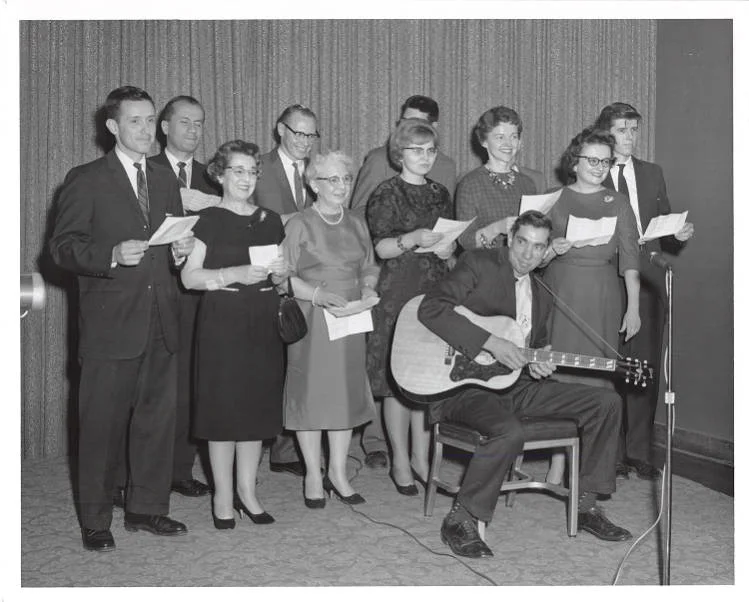
At her retirement dinner, people got up, one after the other, to pay tribute to her. Colleagues presented her with a GE-inspired farewell gift.
Guests: Tell us what it is! A TV set.
Katie Hafner: They sang a song.
Chorus: Katie Blodgett, Katie Blodgett, we’ll miss you, we’ll miss you!
Katie Hafner: It’s the thought that counts 🙂
And Gwen Lloyd, a female colleague, got up and said how much Katharine was missed at the lab.
Gwen Lloyd: This is particularly so in the case of the girls; you are our champion spokesman when we had a cause to plead. We don't know what we are going to do without you.
Katie Hafner: Then, the Mayor of Schenectady presented Katharine with the Patroon award, for outstanding service, the highest honor the city bestows on a resident.
When her turn came to speak, Katharine talked not so much about herself, but Irving Langmuir.
Katharine Burr Blodgett: It had been planned. When I came to Schenectedy today, I was working for Dr. Langmuir,
Nobody knew when Dr. Langmuir would be back.
Dr. Langmuir came home.
Katie Hafner: Listening to this makes you think that it’s a celebration not for her but for him.
Katharine Burr Blodgett: I was privileged to get to know the very human side of Dr. Langmuir.
Katie Hafner: He was the life of the party, wasn’t he?
And with that, Katharine Burr Blodgett retired. The next decade was hard for her. We didn’t see any more evidence of the voices that haunted her throughout her thirties and into her forties, and we hope they quieted down. But into her sixties and seventies her physical health deteriorated.
Here is Katharine’s great-niece, Marijke Alkema:
Marijke Alkema: My family put up guard-like railings to the entrance to my grandma's house to make it easier for her to get in, and then we went to her in Schenectady.
And my impression was that it was a very like. Old person's home. She had one of these chairlifts going up the stairs.
By 1978, Katharine must have known she was at the end of her life, because she wrote to a relative asking if there was room for her at the cemetery in Bucksport, Maine, where both her father and mother are buried. The relative wrote back and, in an almost businesslike tone, informed her that there was no space left at the Maine cemetery.
On October 12, 1979, Katharine Burr Blodgett died at home of a stroke. She was 81.
The New York Times ran a brief obituary the next day, citing the highlights – nonreflecting glass, the color gauge, and, of course, her many years as Irving Langmuir’s assistant.
Then silence.
There was a Katharine Blodgett Day in Schenectady, June 13th, established by the mayor in 1951, but that has since disappeared from the city’s calendar.
At Katharine’s alma mater, Bryn Mawr, the General Electric Foundation established a fellowship program in her honor in 1980, but that program ended 13 years later in 1993.
See what I mean about how forgetting is a process?
We went on the hunt for any more mentions of her through the decades. And there are a few.
There’s a wonderful pamphlet that GE published in 1993 for a Girl Scout event, titled, You Can Be a Woman Scientist, Too!!! It’s written as if it’s Katharine herself speaking to the Girl Scouts, and it’s complete with experiments (like one with M&M’s, for which you need one bag, regular or fun size), a way to visualize thin films, AND her famous popover recipe…
I just had to try this myself…
Zoe Lyon Hiatt: Put everything in a bowl and beat five minutes.
Katie Hafner: My family helped…
Oh, there it goes.
They look like kind of muffins.
Joe Hiatt: And not very good muffins.
Katie Hafner: I wonder what the problem is. Maybe 50 years ago, that's what popovers looked like.
Joe Hiatt: Could be.
Zoe Lyon Hiatt: They definitely didn't pop.
Katie Hafner: Not a lot of poppage.
Zoe Lyon Hiatt: No.
Katie Hafner: This clearly calls for further experimentation.
And how’s this for posthumous recognition: In 2005, Katharine had a cameo in an episode of The Simpsons, when the family visits a new stamp museum that's come to town.
Lisa Simpson: Wow. Look at all these worthy Americans.
Alexander Graham Bell: I'm Alexander Graham Bell, inventor of the telephone.
And there, behind the crystal clear museum glass…
Katharine Burr Blodgett Character: Thanks to me, Katharine Blodgett. We have non-reflecting glass.
Katie Hafner: The episode, of course, assumed that Blodgett’s thin film had yielded the crystal clear museum glass of today. And while that isn’t entirely right, it’s not too far off base. Katharine did give us the foundational science, even if her version of the glass was too soft to commercialize.
We found a couple of research awards – in physics and chemistry – in Katharine’s name in the U.K., where she had gotten her Ph.D.
There wasn’t much more about Katharine to find, but in 2008 her name did crop up again in Schenectady. An elementary school was named for her. We found a clip of the students at that school singing in her honor.
Elementary School Kids: We are the Katharine Burr Blodgett Beagles. I am somebody, I am somebody, who am I? I am somebody.
Katie Hafner: But the school was then renamed, and eventually shut down.
Maybe this is wishful thinking, but I’m hoping this season about Katharine will rekindle some interest among Schenectadians in the city’s own native genius.
While trying to nail down the details of what happened with that Katharine Blodgett school, I called Gary McCarthy, who’s the mayor of Schenectady, and although he didn’t know about Katharine Blodgett at the start of our conversation, after I told him about her, and her work, he offered to put me in touch with the school superintendent, or his deputy.
Gary McCarthy: And you might be able to raise their awareness on some of these things to, uh, get their thinking in different directions.
Katie Hafner: And that is why we’re here, to get every female scientist we shine a light on out into the sunshine of the broader world. Whether it’s a name on a school, or on a street, a building, or a scholarship. Maybe it’s a full, richly detailed Wikipedia page. Or an appearance on The Simpsons. Why not?
Katharine was an inspiration to other women interested in science and gave talks at schools and at meetings of her Zonta club. She influenced at least two of the Blodgett women who came after her. Katharine's niece, Katharine Blodgett Gebbie, also attended Bryn Mawr and became a prominent physicist. In 2015, Katharine Gebbie established a summer research fellowship in her aunt's honor at the college.
And Marijke Alkema, Katharine’s great-niece, credits Katharine with inspiring her to become an electrician.
Marijke Alkema: With each visit, she would bring something as a present for each of us. But what really caught my attention was when we got a make your own doorbell set. I was super excited to wire this up and, uh, put it on the door to my room. I really loved it. I thought like, wow, you know, here you can build something. It works. It's practical. It's electricity.
Katie Hafner: And oh: Katharine’s laboratory notebooks – that crucial record of her working life, her thinking, her days that we spent the season trying to locate... Nowhere in the vestiges of what was once the sprawl of corporate hugeness known as The General Electric Company are there signs that Katharine Blodgett's laboratory notebooks still exist.
We got in touch multiple times with different GE entities -the company split into three in 2024- and we held out hope that the notebooks would show up. Even up to the minute before we recorded this last episode, we hoped that one of those new entities would come through in the end. But it wasn't to be. They responded with emails letting us know they couldn’t help but wished us well. If any of Katharine’s notebooks still existed, no one could tell us where they were and, many email exchanges later we got – very disappointingly– precisely nowhere.
So in the face of all this – emails that politely close doors, archives that go missing, institutions that no longer quite remember what they once made or who made it … I began to ask myself, why does any of this matter?
Why insist on the past when the present seems indifferent to it?
It’s because this history, not just of Katharine Blodgett, but of the rich world that was the General Electric Company’s research laboratory, deserves to be remembered.
History isn’t just a catalog of what happened. It’s the memory of how we came to be who we are.
On a fall day in 1918 in a brick building along the Mohawk River, the men running the GE Research Lab opened their doors to a 20-year-old prodigy who happened to be a woman – she was hired not as a curiosity, not as a token, but as a scientist. And that decision helped shape a world.
The materials that help make our lives possible more than a quarter of the way into the 21st century – our screens, our lenses, our electronic devices, the very way light travels through glass – were built on ideas born in the culture of scientific inquiry Katharine Blodgett stepped into. When we forget that, we don’t just lose names. We lose a sense of how knowledge is made.
Historians remind us that memory is a form of power. To remember is to claim a place in the story. So when we say that Katharine Blodgett matters, we’re not talking about one woman. We’re talking about an era in which science could be bold and collaborative. We’re talking about a laboratory that allowed discoveries to emerge in unexpected ways.
And we’re talking about this very moment, the choices we are making right now about who gets to belong, who gets to be remembered, and what kind of future we’re building.
History matters because it tells us not only who we were, but who we might become. And in remembering Katharine Burr Blodgett, we aren’t just looking backward. Far from it. We are looking for a way forward.
Meg Winslow: We go to our grave lookup, and we put the name in, and then often it's misspelled. So you try another spelling, right, and you try another spelling, and then it comes up on our website.
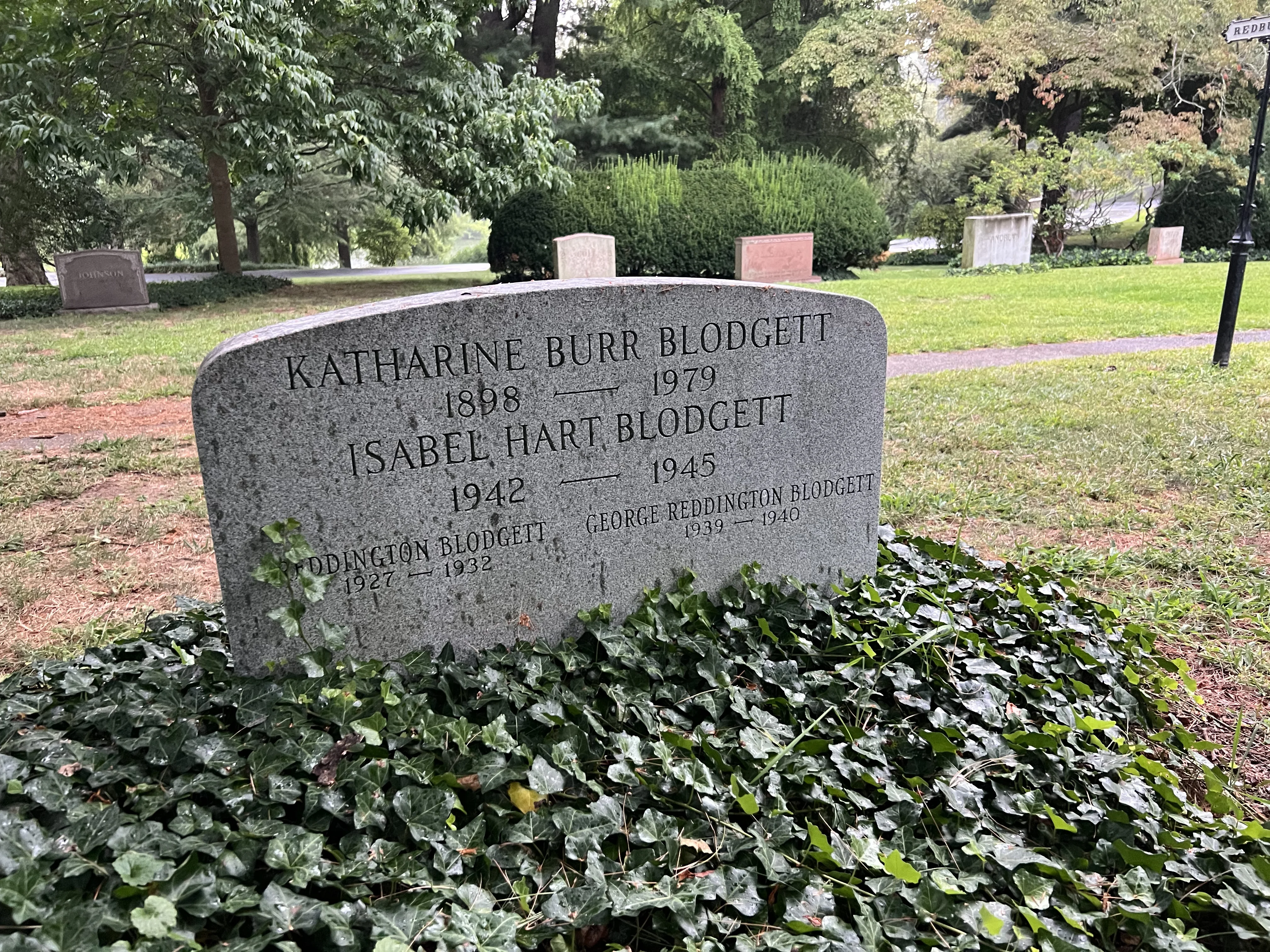
Katie Hafner: That's Meg Winslow, Senior Curator of Historical Collections and Archives at the Mt. Auburn Cemetery in Cambridge, Massachusetts. After her death, Katharine did come to be buried with members of her family.
On a very rainy day last summer, Lost Women of Science associate producer Hannah Sammut went to Mt. Auburn to find Katharine's grave, and she stopped in first to talk to Meg.
Meg Winslow: So Katharine Burr Blodgett is buried on Begonia Path, lot 9243, and she was buried here June 14th, 1980, at the age of 81.
We also have all the records having to do with the shipping and receipt of the cremated remains for Katharine Burr Blodgett.
Hannah then set out to find Katharine’s grave.
Hannah: I hope this was recording. Maybe in true cemetery fashion it is pouring rain!
Um, I am trekking through Begonia Path.
Katie Hafner: She finds the headstone.
Hannah Sammut: Katharine. It's really great to meet you.
Katie Hafner: That really sums it up. It was indeed an honor for all of us to delve into the story of this woman whose life and work we wouldn’t have known to see, unless we looked for her reflected light.
You can remember someone when you are repeatedly reminded of them. The very name Langmuir-Blodgett films might inspire the curious among us to wonder who those two people were and look them up. Or you might send your kids to a school named Katharine Burr Blodgett Elementary.
If you keep talking about someone, aren’t they in some way still here? Which is another reason we’re telling you this story of a scientist who showed us what it’s like to inhabit the world as a full human, even as she struggled with the self she had to live with. But come to think of it, she might well have been the sanest of the lot.
This has been Lost Women of Science. Our producers were Natalia Sanchez Loayza and Sophia Levin, with me, Katie Hafner, as senior producer. Hannah Sammut was our associate producer. Elah Feder was our consulting editor. Ana Tuiran was our sound designer and Hansdale Hsu was our sound engineer.
Elizabeth Younan is our composer and Lisk Feng designed the art.
Thanks to senior managing producer Deborah Unger, program manager Eowyn Burtner, my co-executive producer Amy Scharf, and marketing director Lily Whear.
We got help along the way from Ariel Plotnick, Eva McCullough, Nadia Knoblauch, Theresa Cullen, Issa Block Kwong, Joe Hiatt, and Zoe Lyon Hiatt.
A super special thanks to Peggy Schott, to Chris Hunter at the Museum of Innovation and Science, to George Wise, Bryn Mawr College, and Meg Winslow from the Historical Collections and Archives at the Mt. Auburn Cemetery in Cambridge, Massachusetts.
And we're grateful to Deborah, Jonathan, and Marijke Alkema for helping us tell the story of their great Aunt Katharine.
Dolores: Hey, what about me?
Katie Hafner: Oh yes, Dolores! I gave the first drafts of all my scripts to my AI pal, Dolores, to read aloud using software from the company Descript. Not only did Dolores save me a huge amount of time, but she was a great first pass narrator.
Dolores: Thanks. It's been a pleasure working with you, Katie. I love what you all are doing with Lost Women of Science.
Katie Hafner: We're distributed by PRX and our publishing partner is Scientific American. Our funding comes in part from the Alfred P Sloan Foundation and the Anne Wojcicki Foundation, and our generous individual donors.
Please visit us at lost women of science.org, and don't forget to click on that all-important donate button.
Very soon we’re bringing you a special bonus episode, which we are co-producing with the Science History Institute, about Agnes Pockels, a 19th century self-taught materials scientist whose work was fundamental to Katharine’s discoveries. Keywords: dish soap.
I'm Katie Hafner. See you next time.
Elementary School Kids: “We are the Katharine Burr Blodgett Beagles, I am somebody, I am somebody. Who am I? I am somebody. I am proud and capable and lovable, I am teachable and learn easily…”
Listen to the Next Episode in this Series
More Episodes
Listen to the complete collection of episodes in this series.