


August 6, 2026
A Pioneer Behind X-ray Crystallography, Isabella Karle


August 6, 2026
A Pioneer Behind X-ray Crystallography, Isabella Karle
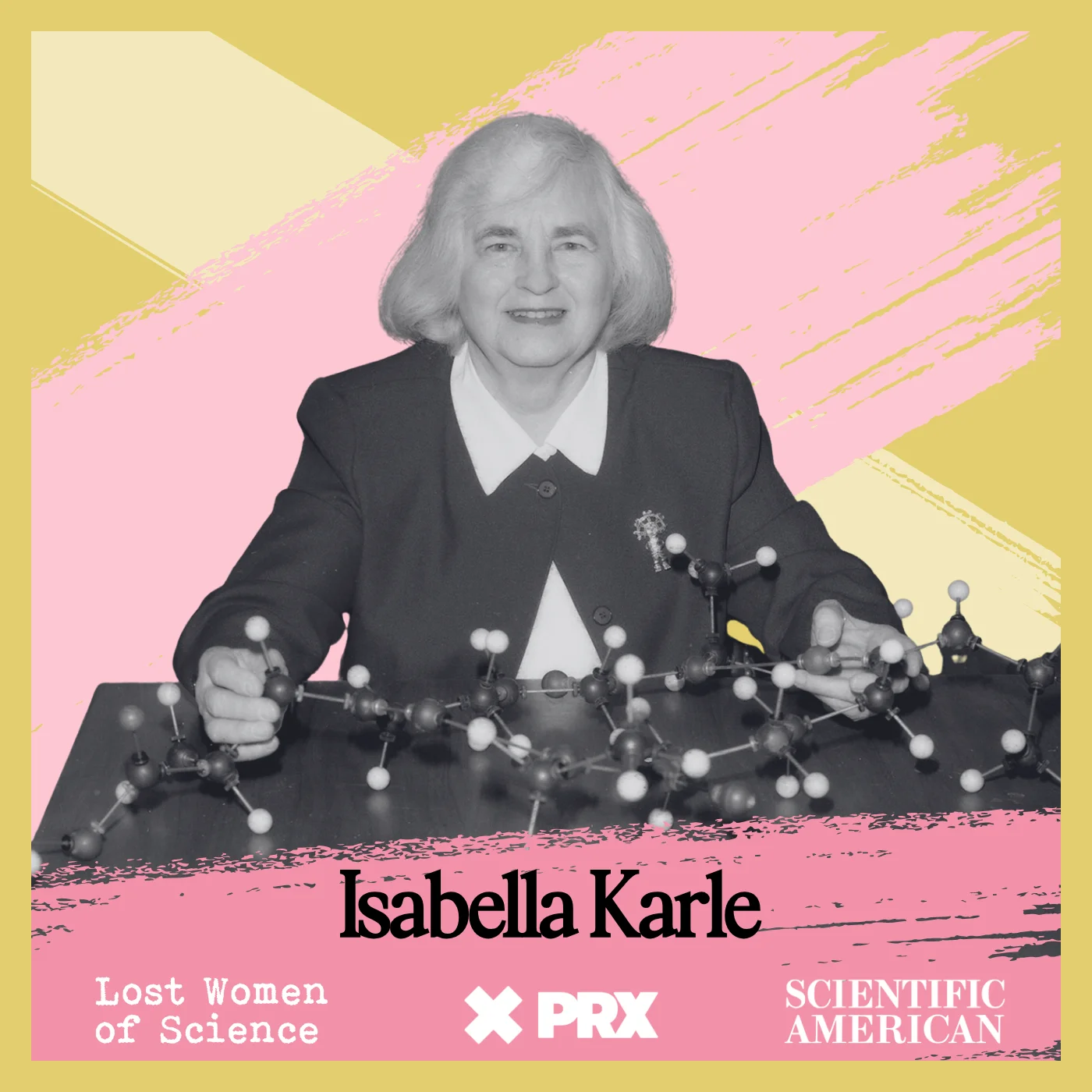
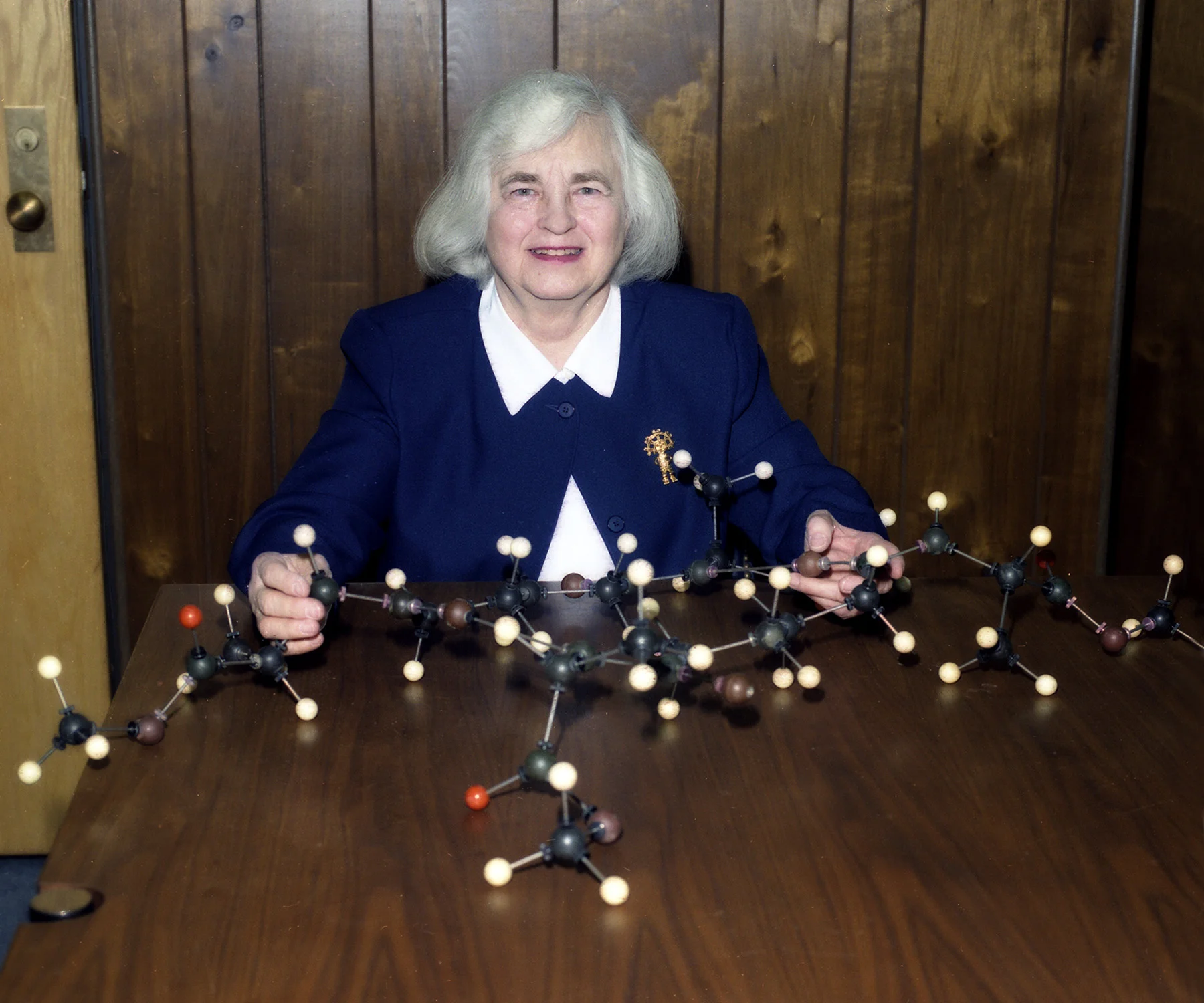
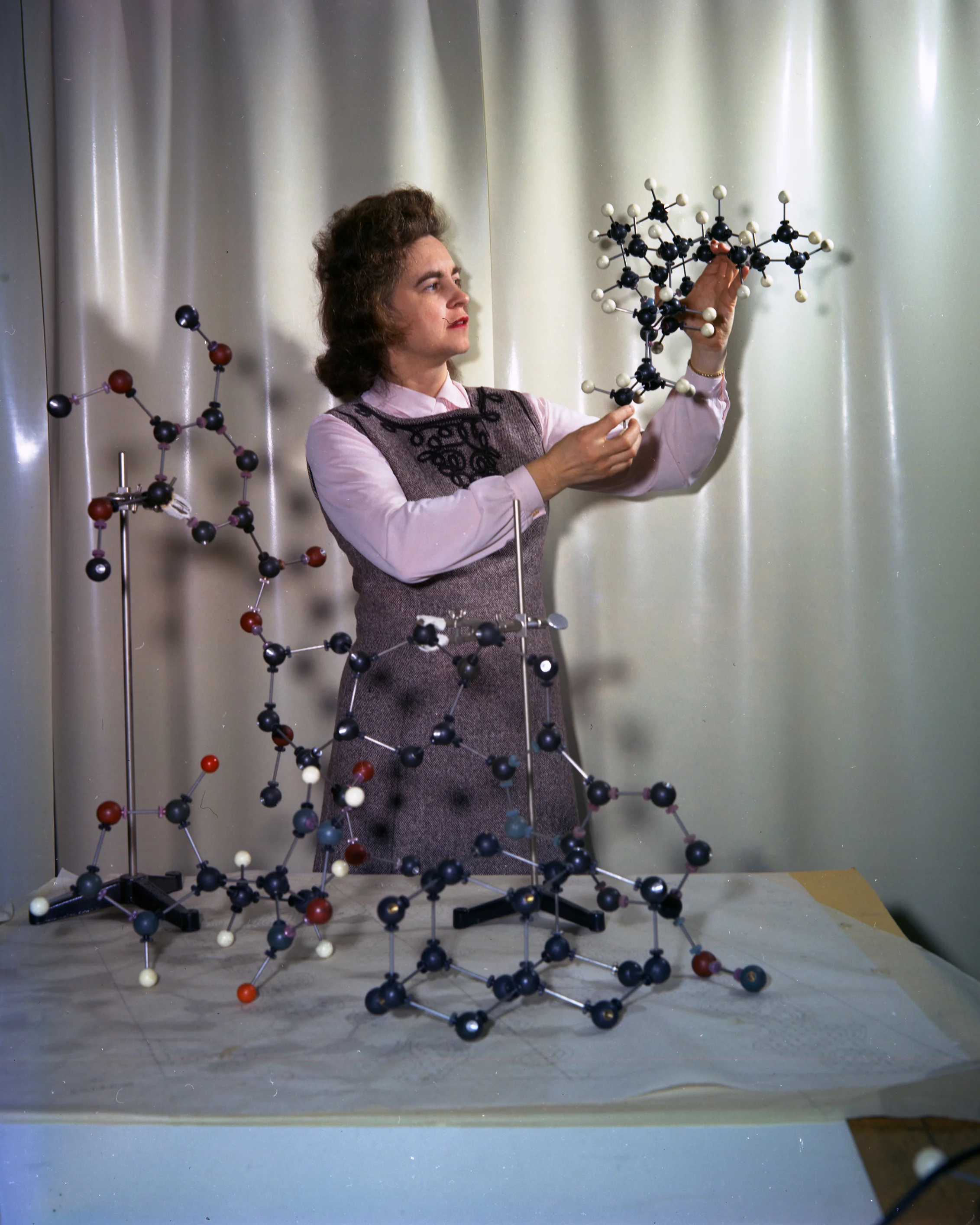
Isabella Karle, a chemist and x-ray crystallographer changed the course of science through her revolutionary, complex discoveries. Why did her husband get all the credit?
Episode Description
In high school, Isabella Karle had to take a science class to fulfill a prerequisite. She chose chemistry, at random. Karle would go on to become one of the most important chemists of her time, doing groundbreaking research in the field of x-ray crystallography. Her discoveries in the mid 1950s are a key reason many modern-day pharmaceuticals are available on pharmacy shelves. But Karle’s collaborator her husband, Jerome would eventually receive the Nobel Prize in Chemistry for work Isabella also achieved.

.webp)

Katie is co-founder and co-executive producer of The Lost Women of Science Initiative. She is the author of six nonfiction books and one novel, and was a longtime reporter for The New York Times. She is at work on her second novel.
Ariel Plotnick is an award winning audio editor, producer, and showrunner. She most recently worked at The Washington Post, where she edited and produced the flagship daily news podcast, Post Reports. She holds a Masters of Journalism from UC Berkeley’s Graduate School of Journalism, as well as a Bachelor’s Degree from Skidmore College.
Katie is co-founder and co-executive producer of The Lost Women of Science Initiative. She is the author of six nonfiction books and one novel, and was a longtime reporter for The New York Times. She is at work on her second novel.
Ariel Plotnick is an award winning audio editor, producer, and showrunner. She most recently worked at The Washington Post, where she edited and produced the flagship daily news podcast, Post Reports. She holds a Masters of Journalism from UC Berkeley’s Graduate School of Journalism, as well as a Bachelor’s Degree from Skidmore College.
Cynthia C. Kelly is the founder and President of the Atomic Heritage Foundation. Before creating the Foundation, she served for more than twenty years as a senior executive with the Department of Energy and Environmental Protection Agency, receiving the Distinguished Career Service Award for her time at both agencies.
Josh Levy is a historian of science and technology at the Library’s Manuscript Division. Before coming to the Library in 2020, he taught courses in history and indigenous studies at the University of South Florida, University of Illinois at Urbana-Champaign, College of Micronesia-FSM, Our Lady of Mercy Catholic High School, and Pohnpei Island Central School. He holds a PhD in modern U.S. history from the University of Illinois, a Master of Theological Studies degree from Harvard Divinity School, and a BA in religious studies from Amherst College.She graduated with a bachelor degree in history from Wellesley College, earned a master’s degree from Yale University, and taught history before her career with the Federal government.
Dr. Chrystal Starbird is an assistant professor of biochemistry and biophysics at the University of North Carolina, Chapel Hill, where she also runs The Starbird Lab. Her research revolves around Receptor Signaling, Protein-Protein Interactions, Structural biology, and Crystallography.


Episode Transcript
A Pioneer Behind X-ray Crystallography, Isabella Karle
Katie Hafner: Every year on December 10th, the country of Sweden holds a very special ceremony.
Guests arrive at Stockholm's premier concert hall in their finest gowns and tuxedos. The King and Queen of Sweden are there, too, sporting crown jewels. All to celebrate Nobel Day, when the Nobel Prizes are bestowed. Nobel Day is full of pomp and circumstance. Hundreds of distinguished guests fill the hall. The Laureates then walk onto the stage and take their seats.
In 1985, the prize for chemistry went to two Americans: Herbert Hauptman, and Jerome Karle.
They were awarded for solving something called “the phase problem.” We’ll get into what that is later. But for now, all you need to know is: it was a really complicated mathematical and chemical problem. And their having solved it is one reason most modern medicine is available today.
Professor Ingvar Lindqvist, a Swedish chemist, conferred the medals to Hauptman and Karle.
Ingvar Lindqvist: Herbert Hauptman and Jerome Karle, on behalf of the Academy I wish to convey to you our warmest congratulations and I now ask you to receive your prizes from the hands of His Majesty the King.
Yet many people, to this day, take issue with a particular fact about that evening’s ceremony. Jerome Karle’s wife, Isabella, sat in the audience watching her husband receive the award. The problem, they say, is that Isabella Karle shouldn’t have been among the onlookers.
She should have been on the stage, sharing the prize with the two men whose achievements were possible only because of the work she did.
I’m Katie Hafner, and this is Lost Women of Science.
Today, how Isabella Karle––one of history’s premier chemists––made breakthrough discoveries in foundational physical chemistry. And, why the Nobel Committee’s decision to leave her off the 1985 prize left the scientific community stunned.
Isabella Lugoski had a gift for math from an early age. In fact, loving numbers is one of her earliest memories.
She was born on December 2nd, 1921. Her parents were both Polish immigrants and the family moved around a bit until they settled in Detroit, Michigan. Isabella’s father worked for the Detroit Transportation System. Her mother was a seamstress, and also owned a restaurant. Little Isabella hung around the restaurant, and that’s where math just started to make sense.
Isabella Karle from an oral history: My earliest, uh, recollections, uh, were in, in the back rooms of the restaurant. It served breakfast and it served large lunches to construction people.
Katie Hafner: That’s Isabella at age 94. It’s from an oral history recorded by the Atomic Heritage Foundation in 2015. Isabella’s mother realized fairly early that her daughter liked numbers.
The butcher brought fresh meat to the restaurant every day and they paid him once a week.
Isabella Karle: So once a week I added up all the numbers of the money that was owed to him.
Katie Hafner: Isabella started public school at 6 years old and she thrived in the classroom, despite Polish being her native language.
Isabella Karle: I was sort of the top girl in the class, and the teachers used to wonder how I did that since I didn't speak English.
Katie Hafner: She skipped 2nd grade. Then she skipped 5th grade, too. But science as a serious interest? It never really occurred to her, until she realized coursework in science was a prerequisite for college.
Isabella Karle: So I picked one out of the air, which was chemistry. And that was a fortunate choice because I thought that the teacher who was a female chemistry teacher, unusual in those days, was a very good teacher.
Katie Hafner: It was that teacher who sparked Isabella's interest in what she was learning.
From then on, chemistry was it for her. She graduated high school at 16, and enrolled at Wayne University, what we now know as Wayne State, to study chemistry. She was the only woman in her chemistry class. Her professor noticed her talent right away. Isabella talked about this in another oral history, recorded in 1987.
Isabella Karle in another oral history: And he said, of course you'll go on to graduate school. Well, I mean, that was nothing I had heard of before. And so he had to explain to me what it was.
Katie Hafner: In 1938, she transferred to the University of Michigan at Ann Arbor. She pursued a physical chemistry degree and sailed through her courses. And then, one day during her senior year, she walked into the lab and…
Isabella Karle: There's a young man in the desk next to mine with his apparatus all set up running his experiment.
Katie Hafner: The young man in question was Jerome Karle. Isabella was used to being the quote “top dog” in class, so she might’ve felt a little competitive, seeing someone else who was as competent as she was.
Isabella Karle: I asked him how did he get in here early and have everything all set up, and he didn't like that.
Katie Hafner: Jerome must’ve quickly realized that Isabella was really smart. They talked a lot about the homework or exam questions and he was impressed by her answers. One thing led to another.
Isabella Karle: He asked to take me to a concert that was going on at Hill Auditorium and we began to see each other.
Katie Hafner: They got married a year later, in 1942. So, Isabella had a husband, a bachelor’s and master’s degree AND her Ph.D., all before she turned 23.
With her degrees conferred, Isabella was ready to work. In 1944 she was selected to work in a chemistry lab at the University of Chicago. There, she joined Jerome, who had already started in the same lab. When she accepted the job, she wasn’t totally sure what she’d be doing.
It wasn't until I arrived in Chicago that she slowly learned that she would be working on the Manhattan Project. Yes, Isabella’s first job out of graduate school was working on the U.S. government’s secret project to develop a nuclear weapon.
When the Manhattan Project started in 1942, scientists there were using Uranium-235––a radioactive isotope––as fuel for the atomic bomb. Cindy Kelly, founder and president of the Atomic Heritage Foundation, explains…
Cindy Kelly: Uranium 235 at the time was thought to be the only fuel. It was the only element that scientists at that point had discovered that you could split with a particle smashing into the middle of it. What happens is that it breaks apart, releases energy…
Katie Hafner: And…causes an explosion! But, developing Uranium-235 in the lab was incredibly laborious. It took a LONG time, and was really hard to do.
So, scientists found another fuel source, one that would be easier and faster to produce: Plutonium.
Cindy Kelly: Plutonium is a manmade element. It's off the charts, so to speak.
Katie Hafner: Plutonium had only just been discovered a few years earlier. It was a huge breakthrough. At the center of every plutonium atom is an extremely unstable nucleus. When scientists hit the nucleus with a single neutron, it splits apart into two smaller atoms. This is called fission. And fission….
Cindy Kelly: Can uh it can create a big, big explosion. Very powerful stuff.
Katie Hafner: When Isabella arrived at the University of Chicago, Isabella was assigned to the Metallurgical Laboratory, to figure out how plutonium worked.
Cindy Kelly: You have to remember this. Plutonium was only discovered the year before in microscopic quantities, and they only hypothesized how it might behave. She was a pioneer. No one had studied the chemistry of plutonium.
Katie Hafner: Her studies at the University of Michigan prepared her well for this moment. She’d spent her years in graduate school using advanced lab equipment to manipulate chemical compounds. And now, it was her job to convert impure plutonium into usable nuclear fuel.
Jerome, meanwhile, was working on the Manhattan Project too. But, they weren’t supposed to talk to each other about their research. Here’s Isabella again talking about this in the Atomic Heritage Foundation recording.
Oral history interviewer: Do you know what, what your husband worked on during the Manhattan Project?
Isabella Karle from oral history: I know what he worked on in general. I didn't really know in particular what it was. We just made it a point not to talk about, well to anybody, what we were doing.
Katie Hafner: Isabella and Jerome finished up their lab work with the Manhattan Project at the end of 1944 and moved back to Ann Arbor. Isabella was appointed as an instructor in chemistry at the University, but the Karles faced a potential obstacle. In the mid 20th century, sexism and anti-nepotism policies meant married couples were rarely both hired by a single university. The husband was traditionally given the faculty position while the wife was expected to essentially give up her career and become a housewife.
But as far as we know, Jerome Karle was every bit as committed to his wife’s career as she was. Becoming a housewife wasn’t an option for either of them. Luckily, there was a place that was eager to have both Karles under one roof.
Isabella Karle: We got an invitation, both of us, to have a permanent job at the Naval Research Laboratory.
Katie Hafner: The Naval Research Laboratory, or the NRL, is based in Washington D.C.
To this day, the NRL is a preeminent spot for scientists and researchers to do important work, and the Karles were excited to get started. In 1946 they moved from Michigan to Northern Virginia to start this new chapter of their lives. At the time, the Karles were particularly interested in a subfield of chemistry called x-ray crystallography. Advances into x-ray crystallography would become the defining research of their lives. But fair warning: it’s really confusing science. So we’re going to do our best to explain the basics.
And this all starts with molecules.
If you transport yourself back to high school biology, you might remember that molecules are teeny tiny. They cannot be seen with the naked eye.
And one big reason you’d want to see molecules is to determine how they’re shaped. If you understand the shape of a molecule, you can understand how it functions, how it might combine with other molecules to create more complex structures, like proteins. And x-ray crystallography is one way to find out how molecules are shaped.
Chrystal Starbird: Extra crystallography is a technique that's used to get atomic level resolution information about molecules that exist in our cells.
Katie Hafner: That’s Dr. Chrystal Starbird. She’s an assistant professor of biochemistry and biophysics at the University of North Carolina at Chapel Hill. And she explained to us how x-ray crystallographers actually figure out the shapes of molecules.
First, the researcher crystallizes a molecule. To do this, they purify or isolate the molecule, and run tests to grow a crystal structure.
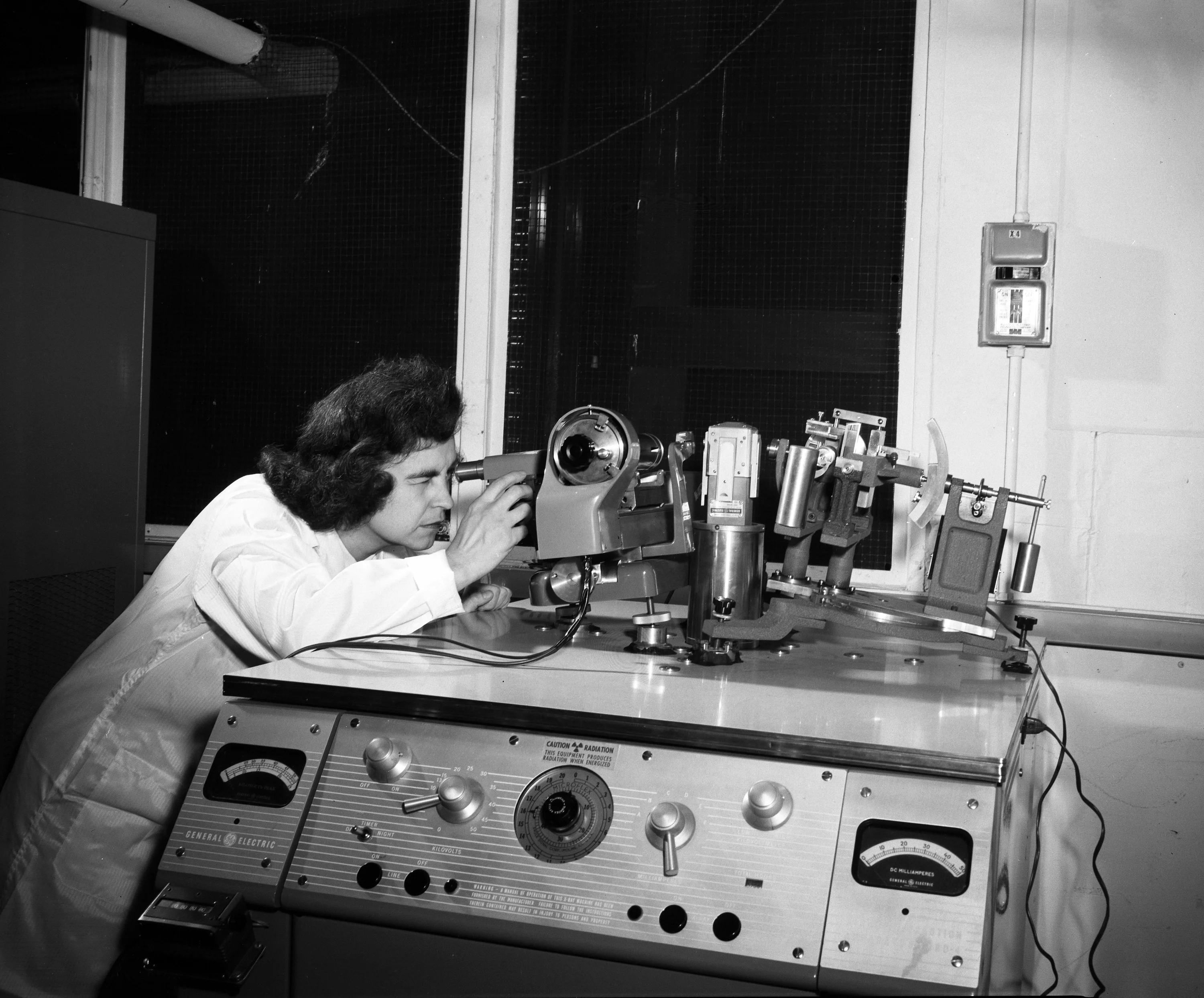
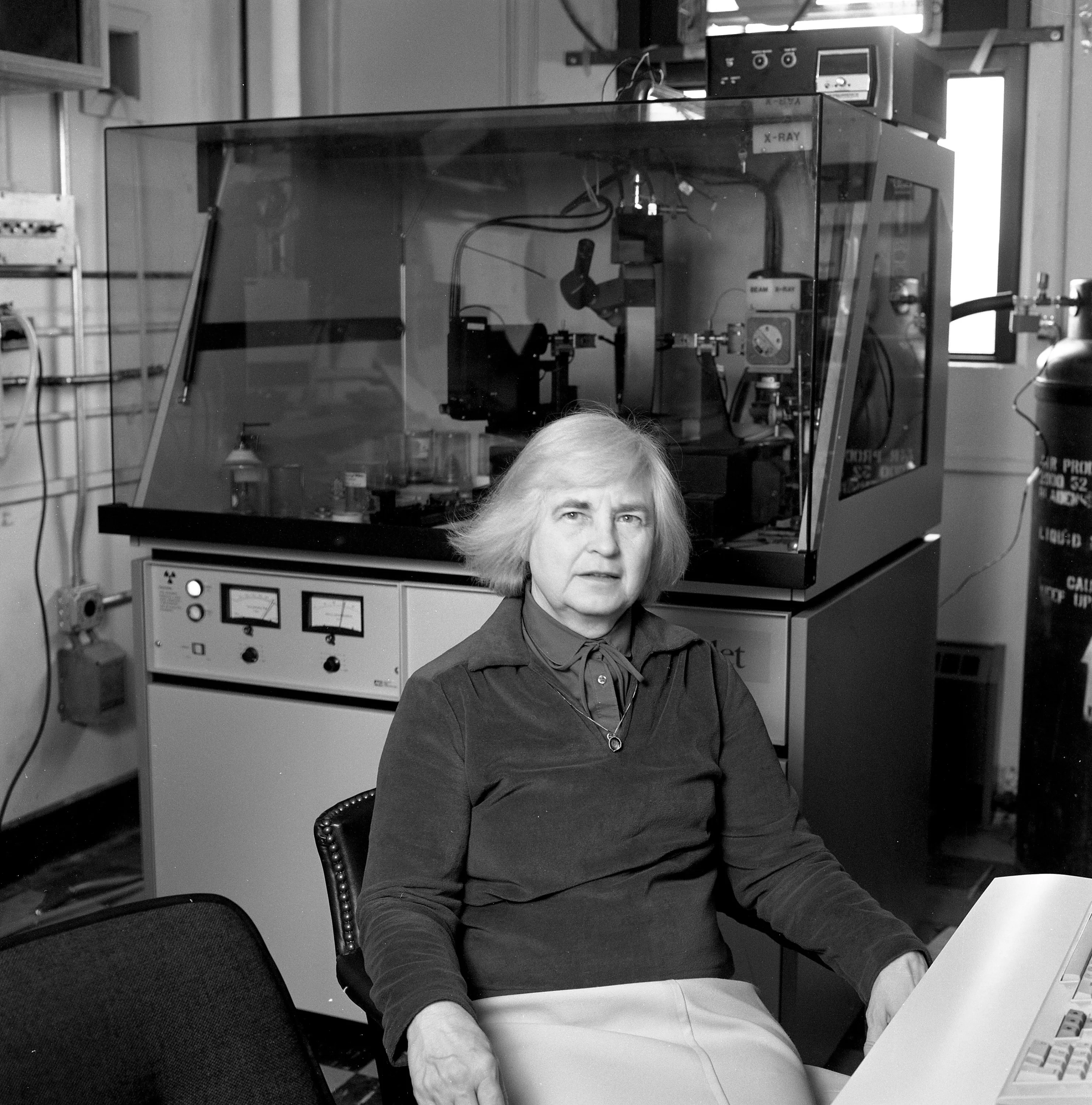
Then, they put the crystal into a machine called an x-ray diffractometer, and they shoot an x-ray beam at the crystal.
The way these electrons behave after bouncing off the crystal reveals something important about the shape of the molecule.
Dr. Starbird used an interesting metaphor to better explain what’s happening here. First, imagine a bunch of people are all in a room, say a gym…
Dr. Chrystal Starbird: There's an invisible truck in the middle of the room. And I want you to imagine that all of us are given basketballs and then our job is to kind of bounce the basketballs off the truck. And when we do that we start to get a sense of the shape based on how the basketballs bounced back to us.
Katie Hafner: So, say you throw the basketball and it bounces back to you really fast. That tells you, oh, maybe I’m pretty close to the truck. Or, you throw the ball, and it comes back to you at a funky angle; you can deduce, maybe that’s the windshield.
Dr. Chrystal Starbird: The point is you start to get an idea of the shape.
Katie Hafner: This is called diffraction information. The angles, the speed at which these electrons bounce back, are all pieces of data we can use to create a visual model of molecules.
And, Dr. Starbird noted, knowing what basic molecules look like, can then help us understand what even more complex structures, like proteins, look like.
Dr. Chrystal Starbird: The more we know about the structure of those proteins, the better we can design therapeutics that directly target those proteins and disease.
Katie Hafner: This work––mapping and structuring cells––is foundational information about the very matter that makes up our world, from plants and animals to complex pharmaceutical compounds. In order to develop new drugs, scientists need to know what molecules and proteins look like.
X-ray crystallography was still a relatively new science in the 1950s, when the Karles really started to dive deep into the field.
And back then, there was a BIG problem many in the crystallography world were trying to solve. It’s called the “phase problem.”
When you’re shooting x-ray beams off a crystal, you get that diffraction information: angles and size. But there are two things you don’t get. And that’s location and distance.
Dr. Chrystal Starbird: Through the crystallography experiment, you get amplitude, you get intensities. So you get these spots that reflect the diffraction, but you lose a little information about location or distance and how they relate to one another
Katie Hafner: Not having that key information, or the “phase” data, prevented scientists from immediately seeing the full shape of the molecule.
Dr. Chrystal Starbird: And so that's essentially the phase problem. Once you have the phase information, you can make sense of all of these spots and how they relate to one another. And then you can sort of build the shape.
Katie Hafner: The Karles believed they could solve the phase problem.
Now, the Karles were not specifically interested in solving the phase problem to, say, create pharmaceuticals, but in taking on this challenge, they were making it possible for future scientists to develop drugs that would change the world.
So, they got to work. First came Jerome’s task. He was more of a theorist who focused on complex equations & abstract concepts.
Starting in 1950, he and a research partner, named Herb Hauptman, buried their heads in complex mathematics. Then, in 1953, they finally solved the phase problem, with a mathematical system called “Direct Methods.”
They published their findings, in a monograph titled “Solution of the Phase Problem The Centrosymmetric Crystal.”
The paper made waves in the crystallography community. This tape is from that same 1987 oral history. This time it’s Jerome speaking.
Jerome Karle in oral history: Most people were intelligently cautious. There were a few who developed hostility.
Katie Hafner: In case you couldn’t make that most people were cautious and a few were downright hostile.
The naysayers didn’t believe direct methods would work. Jerome and Herb realized they'd need hard proof that their equations could actually solve the phase problem. And they knew just who could help: Isabella.
Isabella Karle: Well, by that time, Jerome was quite frustrated that other people were not really trying all of these wonderful formulas that he had on paper. And, uh, I had been doing electron diffraction work here with papers. And so one day he said, why don't you do a crystal structure?
Katie Hafner: More after the break.
Unlike her husband, Isabella was more of a “bench” scientist. She did the physical work of designing and building lab equipment, and then running experiments.
The Karles weren’t shy about this division of labor. In a 1985 interview, Isabella said, “Jerome, did the thinking, and I did the work.”
Isabella and Jerome’s skills were complementary, and made for great collaboration.
Oral history interviewer: How did you divide up the work in your research?
Jerome: It just [fell] naturally into place. People do what they like to do and what
they best do.
Isabella Karle: Most of mine was from the experimental part, working in the laboratory. Most of his was pencil and paper.
Katie Hafner: The Karles had a miraculously healthy working relationship. When asked about how they worked together, Isabella said…
Isabella Karle: We worked next to each other, but we didn't really work together.
Katie Hafner: In another article she said they worked “together but separately.” That dynamic is something they had practiced.
Those early days at The Manhattan Project encouraged a shared mission, but ultimately independent work. Jerome noted their mutual respect for each other’s research.
Jerome Karle: Well, there is obviously, uh, an overlap in our interest perhaps, 25-30% of the work has been collaborative. On the other hand, uh, Isabella has her own research program. She works on all kinds of materials that I do not participate in, we respect each other's talents, which are complementary.
Katie Hafner: Isabella was eager to help Jerome prove that his methods worked. But the type of lab work she had to do to get there was time-consuming and complex. First, she helped build an x-ray diffractometer to run experiments on.
Isabella Karle: In those days, you didn't go out and buy a piece of apparatus, you made it yourself.
Katie Hafner: Isabella then ran calculation after calculation, working her husband’s equations.
According to friends, Isabella would often bring her work home with her, laying out large strips of vellum on the kitchen table, puzzling through the math long into the night.
Eventually, she developed a method known as the “Symbolic Addition Procedure.” Essentially, Isabella came up with an algebraic equation that would allow crystallographers to plug in basic information about molecules.
Dr. Chrystal Starbird: So basically the idea is that you're putting symbols in to represent the phases that are unknown at the early phase of calculation.
Katie Hafner: As you continue to add data, the equation would then yield the “phase” information, that missing piece of the puzzle scientists need to determine the shapes of molecules.
Dr. Chrystal Starbird: Today these are computational problems, right? People just essentially go in and they put in the data and the computer will do the work that she did during that time.
Katie Hafner: Isabella’s discovery meant that molecules could finally be visualized. Instead of spending weeks trying to guess exact molecule structures, scientists could now use a simple formula to get fundamental information about how cells work.
The crystallography community and wider scientific world didn’t just quietly accept the breakthroughs the Karles made, they celebrated it, which brings us back to where we started:
1985, when Jerome Karle and Herb Hauptman won the Nobel Prize in Chemistry for solving the phase problem.
Jerome was on a plane, coming home from a conference in Germany, when he found out.
Jerome Karle from oral history: About two hours before we landed, an announcement came over the loud speaker. Started out with telling about the weather in Washington, and… but he got around to saying that, uh, he doesn't know it, but the latest recipient of the Nobel Prize in chemistry is aboard.
Katie Hafner: Reportedly, Jerome was immediately eager to find out if his wife had won as well, and was stunned to find out she was not included.
There is a huge archive of Isabella and Jerome’s papers at the Library of Congress in Washington, D.C.
Josh Levy, a historian with the Library, has cited the evidence of how the Nobel’s snub of Isabella really stuck with Jerome.
Josh Levy: He brought this up quite a lot, um, for, for decades, and that it was something that, um, that might have eaten at him.
Katie Hafner: At a Pentagon press conference after his award was announced, Jerome Karle didn’t miss the opportunity to say so publicly. We asked my step-son, Benji, who’s our in-house voice actor, to read Jerome’s remark.
Benji as Jerome Karle: "The efforts of Mrs. Karle are also truly deserving of an award of the level which we have received."
Katie Hafner: In a 1985 interview, Jerome was asked whether he felt Isabella had been properly celebrated. And, he replied, and this is his quote, “her work in the 1960s was not only valuable, it was indispensable. The record shows she should be credited with prime contribution.”
So these public statements were powerful, but Jerome didn’t stop there. Actually, most of his advocacy on Isabella’s behalf was done privately, out of the press. Our senior producer Ariel Plotnick noticed this.
Ariel Plotnick: So, I reviewed pages and pages of original documents in the Karle collection at the Library of Congress. And, you know, first, I found multiple letters to scientific publications where Jerome requested that Isabella be properly credited for work that had been misattributed to male scientists. I also found fan mail.
Josh Levy: two decades after he wins the Nobel Prize, he receives a letter from an autograph seeker in Oklahoma and says, "Can you autograph this press release from the Nobel Committee?" And he says, "I, I've never seen that before. I can't autograph this. It, it underrepresents Isabella's contributions to my work."
Ariel Plotnick: But the most fascinating part of this archive, for me, was this: Jerome had actually nominated Isabella for a Nobel prize 10 times! You can see documentation of this in the archives. He first nominated her in 1977, 8 years before he was awarded the prize.
Katie Hafner: Here’s a passage from a letter he wrote to The Nobel Committee for Chemistry in 1977 read by Benji.
Benji as Jerome Karle: “After much careful consideration, I came to the conclusion that a most qualified nominee would be Isabella L. Karle. I have hesitated to submit a nomination for her because she is my wife. Isabella is quite unaware of your kind invitation to me to propose nominations for the Nobel Prize in Chemistry.”
Katie Hafner: Why, exactly, was Jerome intent on keeping this information from Isabella? Josh Levy has a theory, based on letters that Jerome wrote to fellow scientists:
Josh Levy: He is concerned that by nominating her, it might be seen as inappropriate because he is married to her and, uh, and that it might hurt her in some way. He's concerned about, not having the, the situation appear as though Isabella is, is lobbying through him or that he's doing something that could be seen as unseemly or inappropriate.
Katie Hafner: It seems, Jerome was doing his best to advocate for his wife at a time when recognizing women’s contributions was not particularly important to the scientific community.
And that might be a clue as to why Isabella was left off of the Nobel prize in the first place.
Unfortunately, the public records for the Nobel Prize Committee’s deliberations at the time won’t be available to view for another ten years. That’ll be 2036, so it’s impossible to say for sure.
But, many people have suggested that it was simply, you guessed it, sexism. From 1901-1985, the Nobel Committee awarded 990 people the Nobel prize. How many of those were women? 67.
And, that sexism also bled into the value system around the scientific process itself. Scholars have noted that perhaps the Nobel Committee had a preference for theoretical work rather than benchwork––terms that were highly gender coded at the time. Here’s Josh Levy again.
Josh Levy: People have written about, um, what kind of science is valorized, what sort of science is, is made prestigious or awarded. And it's not always the case, but it often was the case that in the 20th century, the people that were most likely to be rewarded for their science were the theorists, and the people that were most likely to be theorists were men.
Katie Hafner: Women, however, were more likely to be the experimenters, the teachers, the researchers doing the physical work in the lab.
Josh Levy: Some people have suggested that maybe being a theorist sounds sort of bold and path breaking and, you know, it's sort of about, like, action and, and energy. And being an experimenter is more about careful work where you're, you're kind of piecing things together. Those are both kind of fantasies of what the work was in real life.
Katie Hafner: Jerome wasn’t the only person who wrestled with Isabella being excluded from the Nobel Prize. In a letter to Jerome after the prize was announced, a chemistry professor at Boston University wrote:
“I want to congratulate both of you most warmly…and I specifically want to include both of you in my congratulations, because I am not sure that it would all have been possible without Isabella’s considerable contributions….it was as much Isabella’s work as Jerry’s.”
Katie Hafner: The Karles had three daughters. And one of them, Louise, was also disappointed in the Nobel Committee’s decision.
In a 1985 interview with the Washington Times, Louise said her mother had worked side-by-side with her father for years, and that without her, it would have taken much longer for the methods that Jerome and Herbert Hauptman developed to be accepted.”
So, how did Isabella feel about all of this? In looking through the Karle papers at the Library of Congress, we saw very few public comments from Isabella on that delicate topic––the topic of getting appropriate credit.
We did find, in a volume of interviews, one direct and fascinating exchange she had with a fellow chemist, named Magdolna Hargittai (MAHG-dole-nuh Hahr-JIH-TYE).
First, Dr. Hargittai asks “Does it ever happen that Jerome gets the credit for what you did?”.
And then, Isabella Karle says, “I suppose so.”
And then Dr. Hargittai says, “Does it ever happen the other way around?”
To which Isabella says, “Not often.”
Dr. Hargittai also asked Isabella directly about being left off the Nobel Prize. And here’s how Isabella answered that: “It would have been nice to have it. On the other hand, I have received many awards of my own, which are significant and which satisfy me.”
And that is the most direct reflection from Isabella we could find. Josh points out that it might not have been totally advantageous for her to talk about the Nobel kerfuffle––either politically, or for her mental health.
Josh Levy: How much could Isabella express disappointment publicly? Uh, maybe she felt she couldn't express it very loudly or strongly. Maybe she didn't want to express it. It can be a destructive loop to obsess over the loss of an award like this when, of course, she was not pursuing the scientific work only to get a Nobel Prize.
Katie Hafner: But also, it's possible she wasn't that bothered by the whole thing. In some interviews, she sounds almost indifferent.
Isabella Karle from an interview: So he got the Nobel Prize for that work. I got other awards.
Katie Hafner: “I got other awards” is an understatement. Isabella Karle went on to receive numerous others, including the 1995 National Medal of Science given to her by President Bill Clinton and Vice President Al Gore.
Bill Clinton clip: Today it is a great honor for both the Vice President and me to honor outstanding Americans whose contributions to science and technology have enriched. Not only the United States, but the entire world.
Katie Hafner: Isabella’s scientific life did not stop just because the Nobel Prize snubbed her. In fact, her career was varied and filled with seemingly endless projects.
Josh Levy: We do have papers of some scientists in our collections in which they clearly did one very important thing that stands by itself. And sometimes scientists who do that one important thing, or inventors who invent the airplane or the telephone or something like that. The rest of their career sort of feels like, you know, like they've passed over the hill, and then they're just sort of, you know, rolling leisurely down, you know, for the rest of their career. You don't get the impression with Isabella.
Katie Hafner: She went on to do breakthrough research on peptides and frog toxins. She discovered treatments for mushroom poisoning and excessive body swelling.
When asked in interviews about being a woman in a male dominated field, she often shrugged. Sure, there were challenges, but being the only woman in a lab, it didn’t faze her.
Isabella Karle: When I went through college, sometimes I was the only girl in the class, and that didn't seem to bother me.
Katie Hafner: And as far as she could tell, it didn't seem to bother most of her classmates either.
Isabella Karle: I'm sure there are people who didn't like the idea of having women around, but they didn't get in my way.
Katie Hafner: This determination, and even a bit of nonchalance, might’ve been one of the keys to Isabella’s success. At a time when so many women had to abandon their scientific dreams, she was able to spend her life as a working scientist.
Josh Levy: She's able to, to tell a story in which she was able to basically get the career that she wanted.
Katie Hafner: Whether she meant to be or not, Isabella was a role model for budding scientists all over the world.
She gave speeches at conferences and award ceremonies, encouraging the next generation of scientists to pursue their dreams.
Isabella and Jerome Karle left behind a 63 year legacy at the Naval Research Laboratory. In their honor, the Lab has named a conference room after them. They both died in their 90s; Jerome in 2013 when he was 94 and Isabella in 2017 when she was 95.
When asked to reflect on her life at age 93 in the Atomic Heritage Foundation’s Oral History, Isabella described it as an extraordinary ride. The Nobel Prize didn’t come up.
Isabella Karle: I suppose all I can say is that I enjoyed all the scientific work that I was involved in. I enjoyed bringing up a family. I also enjoyed running around the world, so all kinds of good things happened, and fortunately, we didn't have any disasters, catastrophes, bad health. And not all people are that fortunate.
Katie Hafner: This episode of Lost Women of Science was produced by Ariel Plotnick. Our senior managing producer is Natalia Sánchez Loayza.
Sean Carter was our sound designer and engineer. Lizzie Younan composed all of our music. We had fact-checking help from Danya AbdelHameid.
Thank you to Atomic Heritage Foundation and the National Museum of Nuclear Science & History, SVT, Sweden’s public television broadcaster, and The Science History Institute for use of their archival audio featuring Isabella and Jerome Karle.
Thank you also to the Naval Research Laboratory, and to the Library of Congress.
Thanks to Benji Wachter, Eowyn Burtner, Lily Whear, and Amy Scharf, my co-executive producer.
Lost Women of Science is funded in part by the Alfred P. Sloan Foundation, the Anne Wojcicki Foundation, and many generous individual donors. We’re distributed by PRX.
For show notes and an episode transcript, head to lostwomenofscience.org, where you can also support our work by hitting that donate button.
I’m your host, Katie Hafner. See you next time!
Listen to the Next Episode in this Series
More Episodes
Listen to the complete collection of episodes in this series.
