


October 29, 2026
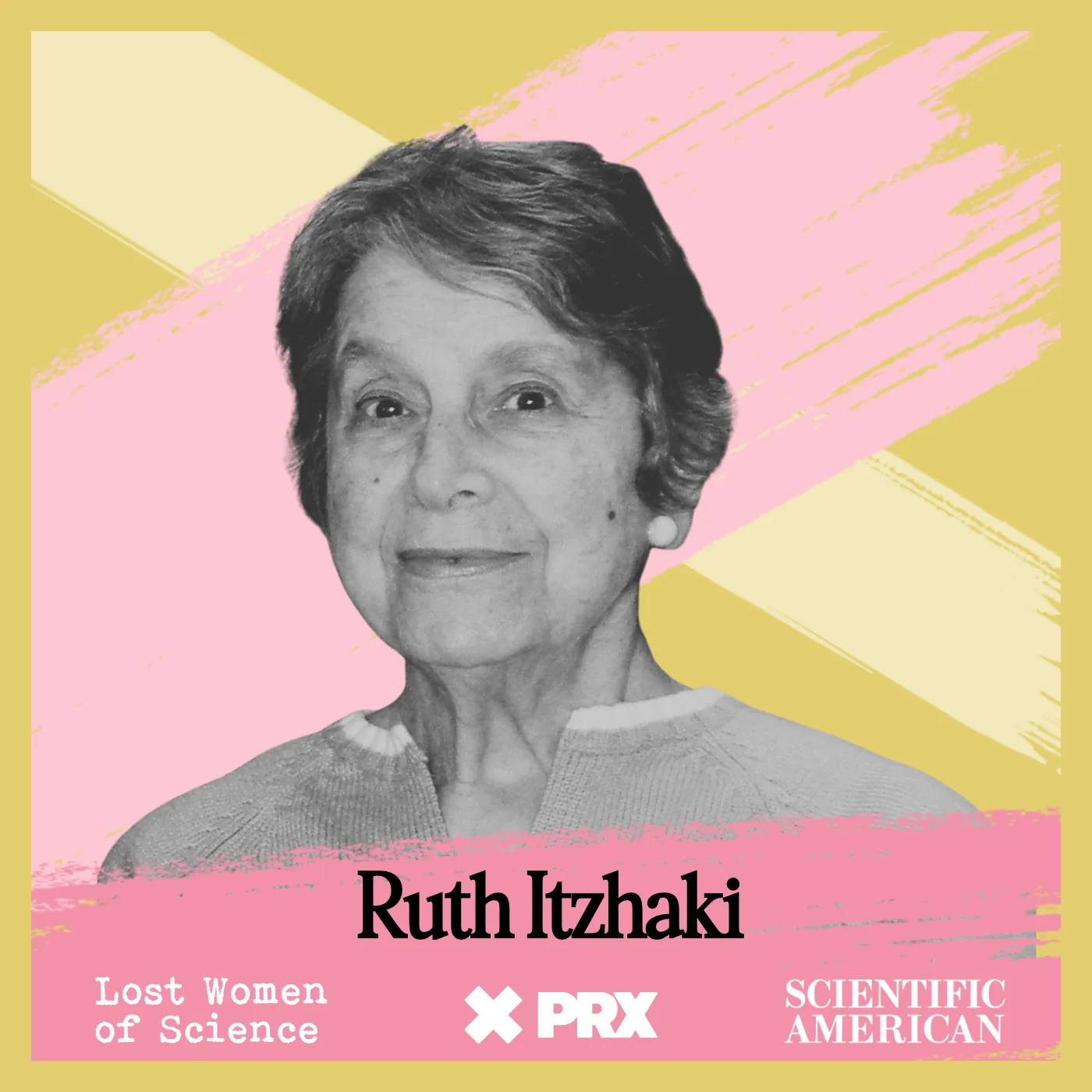
Ruth Itzhaki: Could anti-virals prevent Alzheimer’s?


October 29, 2026
Ruth Itzhaki: Could anti-virals prevent Alzheimer’s?
And could the herpes virus trigger it? For decades, Ruth Itzhaki asked herself these questions and pursued a controversial theory that made her less than popular in her field. Could she be right?
Episode Description
For decades, Ruth Itzhaki has pursued an idea that many in the Alzheimer’s research community were reluctant to take seriously: that herpes simplex virus type 1, the virus best known for causing cold sores, is also a major cause of Alzheimer’s disease in genetically vulnerable people.
But as a different hypothesis became dominant in her field, Itzhaki found herself struggling to secure funding and recognition for her work.
In this episode: What happens when a scientist spends a lifetime pursuing an idea that most of her field doesn’t find convincing? And where does Ruth Itzhaki’s idea stand today?


Katie is co-founder and co-executive producer of The Lost Women of Science Initiative. She is the author of six non-fiction books and one novel, and was a longtime reporter for The New York Times. She is at work on her second novel.

Elah is a journalist, audio producer, and editor. Her work has appeared on Science Friday, Undiscovered, Science Diction, Planet Money, and various Canadian Broadcasting Company radio shows.
Katie is co-founder and co-executive producer of The Lost Women of Science Initiative. She is the author of six non-fiction books and one novel, and was a longtime reporter for The New York Times. She is at work on her second novel.
Elah is a journalist, audio producer, and editor. Her work has appeared on Science Friday, Undiscovered, Science Diction, Planet Money, and various Canadian Broadcasting Company radio shows.
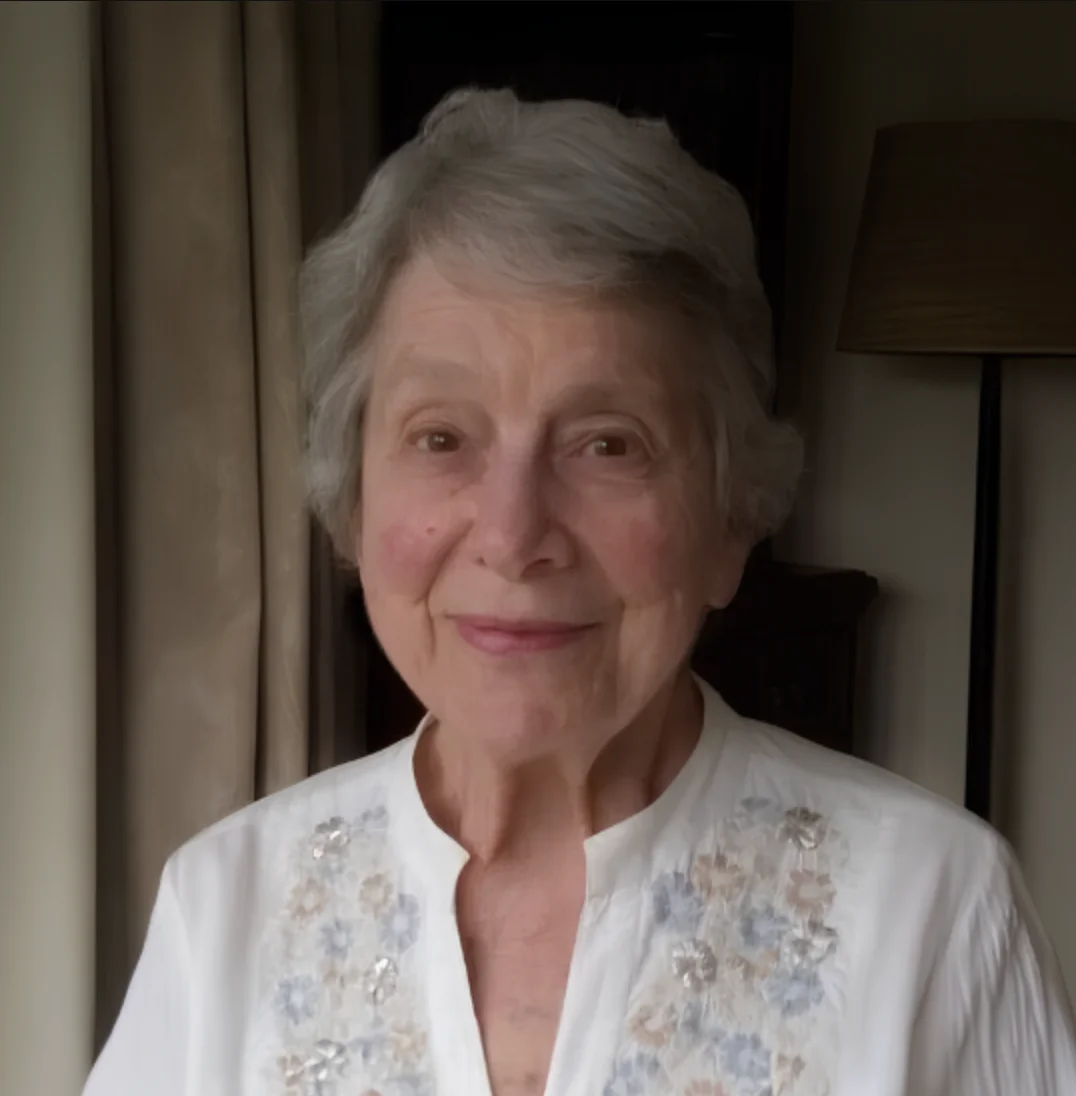
Ruth Itzhaki is a visiting professorial fellow at the Oxford Institute of Population Aging and an emeritus professor at the University of Manchester. Her research has focused on the possible role of herpes simplex virus in Alzheimer’s disease.
Charles Piller is an investigative journalist for Science and the author of Doctored, a book examining the history and controversies of Alzheimer’s research.
Dennis Selkoe is a neurologist and Alzheimer’s researcher at Harvard Medical School whose work has focused extensively on amyloid-beta and the biology of Alzheimer’s disease. He is on the board of directors of Prothena and serves as an ad hoc consultant for Eisai and Roche.
Michael Heneka is a neurologist and researcher whose work focuses on neuroinflammation and its role in neurodegenerative diseases including Alzheimer’s. He is on the scientific advisory boards of Muna Therapeutics, Alector Inc., CaspAId Inc. AnzonBio2, Aperture and the Dementia Discovery Fund.


Further Reading:
Lecanemab in Early Alzheimer’s Disease, van Dyck et al., 2022
Doctored, Charles Piller, 2024.
Herpes simplex virus type 1 in brain and risk of Alzheimer's disease, Ruth Itzhaki, 1997.
Herpes simplex virus type 1 in Alzheimer's disease: the enemy within, Ruth Itzhaki, Matthew Wozniak, 2008.
Long‐term safety and efficacy of lecanemab in early Alzheimer's disease: Results from the clarity AD open‐label extension study, van Dyck et al., 2025
The Lecanemab Clarity AD Open‐Label Extension in Early Alzheimer’s Disease: Initial Findings From the 48‐Month Analysis, van Dyck et al., 2025.
Association Between Herpes Zoster Vaccination and Dementia Risk: A Systematic Review and Meta-Analysis, Zhang et al., 2026.
Anti-herpetic treatment reduces dementia risk: A systematic review and meta-analysis, Chang et al., 2026.
The maddening saga of how an Alzheimer’s ‘cabal’ thwarted progress toward a cure for decades, Begley, 2019.
Anti-amyloid Alzheimer’s drugs show no clinically meaningful effect, Cochrane, 2026.
Recent Cochrane review has serious flaws: A perspective of clinicians and researchers from around the world, Snyder et al., 2026.
Episode Transcript
Ruth Itzhaki: Could anti-virals prevent Alzheimer’s?
Elah Feder: Katie, today I wanna take you back to the late 1980s
Katie Hafner: What was happening in the 1980s?
Elah Feder: Well, a lot of things, but here's, here's the part I wanna tell you about. In the late '80s, interest in Alzheimer's was booming. The general public had only recently become acquainted with even the concept of Alzheimer's disease, that this was a very specific kind of dementia and not just an inevitable product of old age.
Katie Hafner: and before the 1980s, just to be clear, people referred to it as just senility,
Elah Feder: Yeah, senile dementia, senility. But in the 1980s, there was massive growth in public awareness, and researchers were furiously working on this problem.
Ruth Itzhaki: Nobody knew anything about Alzheimer's. I mean, they still know very little. And so it was a really, a great challenge, which I thought was very, very exciting.
Elah Feder: Ruth Itzhaki was one of these researchers. She was at the University of Manchester Institute of Science and Technology in the UK. And to start with, she and some colleagues tested a very prominent theory at the time that Alzheimer's was caused by aluminum.
Ruth Itzhaki: But, I found that technically it was almost impossible to do because of aluminum everywhere. So we decided after a couple of years to stop that particular work.
Elah Feder: So then Ruth went in a very different direction. A few years earlier, in 1982, a neuropathologist in Canada had published an intriguing study where he noted that there was an overlap in the areas of the brain affected in Alzheimer's and in a condition called herpes simplex encephalitis, which is a very serious inflammation of the brain caused by the herpes simplex virus., This led him to an idea: what if the herpes simplex virus also caused Alzheimer's? This seemed plausible to Ruth for a couple of reasons.
Ruth Itzhaki: Firstly, the virus is very common.
Elah Feder: Especially herpes simplex virus type one, or HSV-1. This is the virus best known for causing cold sores.
Ruth Itzhaki: It was actually much more common then than now, and also the fact that it can go latent. In other words, it can get into the body after infection and it can stay there for the rest of the person's life. But can awaken, become reactivated by various events such as immunosuppression.
Elah Feder: So in the late 1980s, Ruth and a team decided to test this. This would've been really difficult to do just a few years before, but by the late '80s they had access to what was then a pretty new technique: polymerase chain reaction.
Ruth Itzhaki: PCR started really a new era because you could detect things that you couldn't do before.
Elah Feder: They could use it to look for virus DNA in brain tissue. Ruth and her team got 14 brains. These were all from older people who had died. and donated their brains to medical research. Eight had Alzheimer's, six did not. And they checked those brains for the HSV1 virus.
Katie Hafner: And what did they find?
Elah Feder: They found the virus in all of the brains.
Ruth Itzhaki: I was very disappointed because I thought naively that maybe we'd find the virus and the Alzheimer's, but not in the normals. But that wasn't the case.
Elah Feder: It didn't matter if they had Alzheimer's or they didn't have Alzheimer's.
Katie Hafner: So there goes that theory, right?
Elah Feder: It would seem so. but this was not the end of the story. What followed was a truly remarkable set of discoveries that would put Ruth squarely on the outside of mainstream Alzheimer's research and make her less than popular in her field.
Katie Hafner: I’m Katie Hafner, And this is Lost Women of Science
Elah Feder: And I'm Ella Feder. Despite decades of research, the prognosis for Alzheimer's remains dire. Some suggest we finally turned a corner, but others have blasted the slow progress, blaming it on a research community that's closed off to new ideas.
But which ideas should they be open to, And which are just too fringe to waste their time on?
Today, we're talking about Ruth Itzhaki and the idea she's dedicated her career to: That Alzheimer's disease is caused, at least in part, by a herpes virus in the brain.
Katie Hafner: So Ella, this episode is a real departure for us. Usually the, the criterion for being featured in Lost Women of Science is that you have to be dead,
Elah Feder: And forgotten, right?
Katie Hafner: But Ruth Itzhaki, she's alive, she's working, so how do you figure she's lost?
Elah Feder: Yeah, I don't usually get to speak with the women we cover because, as you mentioned, they're usually dead and quite some time ago. But here's why I thought we needed this episode. On the road to being forgotten, many of our lost women, they were sidelined, they were discounted, and I never get to ask them about it directly.
So I wanted to talk to Ruth herself about this experience but my interest in this actually goes beyond Ruth. Back in 2019, I saw an investigation in Stat News which had a very provocative headline. It said that an Alzheimer's "cabal" had thwarted progress toward a cure by the late Sharon Begley. Did you see this article?
Katie Hafner: Yes, and it's a real eye-opener
Elah Feder: Yeah. So she argued that Alzheimer's research had been stalled for decades because the field has been hung up on one flawed theory and that it has shut out anyone who disagrees, including Ruth Itzhaki, she spoke with her.
Katie Hafner: But Sharon Begley pointed out, the research community refused to concede that it, that the theory was flawed, right?
Elah Feder: That's right. Many respected scientists definitely stand by it when I saw this article, not knowing anything about Alzheimer's research, I was like, "Well, this is it. Everything's about to change. Sharon Begley has, you know, busted this case wide open." Um, that's not what happened
Katie Hafner: not what happened. So tell me about this prevailing theory.
Elah Feder: It's called the amyloid hypothesis.
Charles PIller: Let me go back to the very beginning.
Elah Feder: Charles Piller writes investigative stories for science, and last year he published a book investigating the state of Alzheimer's research, which we will get to a bit later. But first, a history lesson.
Charles PIller: More than 100 years ago, at that time, at the beginning of the 20th century, the namesake of this disease, Dr. Alzheimer.
Elah Feder: That's Alois Alzheimer.
Charles PIller: From Germany, was treating a patient who had the symptoms of dementia.
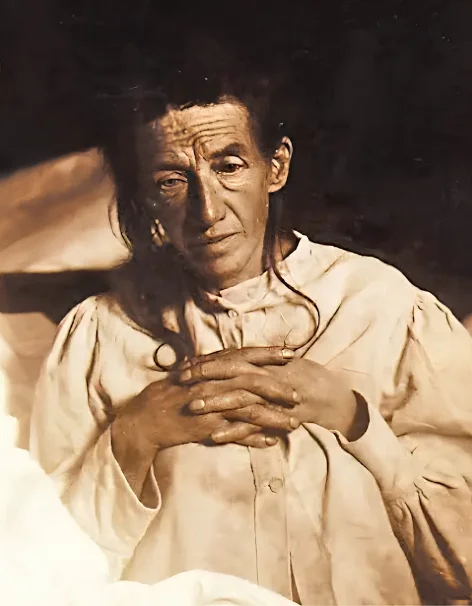
Elah Feder: The patient's name was Augusta. She was only 51 years old, and she couldn't answer basic questions.
The doctor asked her, "When were you born?" She said, " This year. No, last year." He asked her her husband's name, and she gave her own. And she also told him that she was feeling very anxious. Augusta continued to deteriorate over the next few years, and she died just before her 56th birthday. After she died, Dr. Alzheimer looked at her brain. He saw significant atrophy, and then when he looked under a microscope…
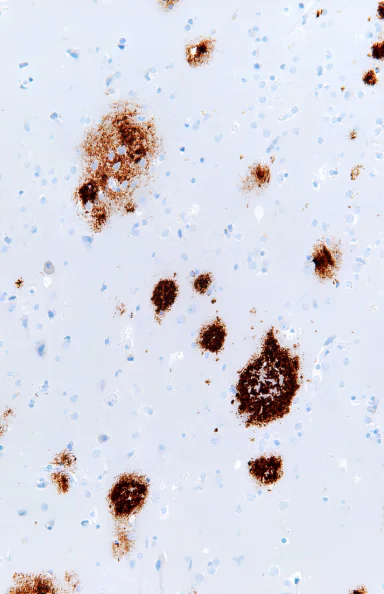
Charles: He found within her brain two kinds of proteins, these so-called sticky plaques, amyloid plaques, that are the characteristic proteins of Alzheimer's disease, and also something called tau proteins which exist within the neurons, the brain cells.
Elah Feder: Dr. Alzheimer didn't have those terms at the time. That's what we call them today. But in any case, amyloid beta plaques and tau tangles, both of them are clumps of protein or protein fragments, and these became the two hallmarks of Alzheimer's.
Katie Hafner: Are these something that we have in our brain anyway and that just, it just, it's increased or do they…?
Elah Feder: Tau protein for sure.
It's important for stabilizing these little structures called microtubules but in Alzheimer's, it just, the tau clumps up, forming these tangles.
Amyloid beta, not so clear, but there's some evidence that it could actually have neuroprotective effects.
What we do know is that you definitely can find amyloid beta plaques in people without any dementia. It gets more and more common as people get older
Katie Hafner: And then what role do these play in Alzheimer's?
Elah Feder: Well, this is the question. Alois Alzheimer definitely didn't know the answer, and in the decades after his discovery, people floated ideas, but nothing really stuck until the early 1990s. That's when the amyloid hypothesis really takes hold.
There's a really famous paper from 1992 by John Hardy and Gerald Higgins. It's been cited more than 10,000 times, and the crux of it is that the deposition of this amyloid beta protein is the pivotal thing. It's what sets off a cascade that leads to tau tangles and ultimately to neurons dying.
Charles PIller: This hypothesis then took hold in the entire industry, if you will, of Alzheimer's disease research and drug development, and it did it because it was logical.
Elah Feder: Enter Ruth.
Katie Hafner: Enter Ruth.
Elah Feder: Now, Ruth started her research, as I mentioned, in the late '80s, so it was a little before this amyloid hypothesis became totally cemented as the, the leading idea. Ruth's idea was that a virus caused Alzheimer's,
Katie Hafner: But in that first study that we talked about, the virus is in all the brains, even the ones without the Alzheimer's. I mean, that, doesn't that seem to contradict her idea?
Elah Feder: You would think so, but then there was a major discovery, not by Ruth, but one that gave her an idea.
So in 1993, a team from Duke University identified a gene that's strongly linked to the risk of developing late-onset Alzheimer's. You might have heard of it. It's a gene called apolipoprotein E, APOE for short, and having the epsilon four variant of this gene, it increases your risk of Alzheimer's by two to three-fold. And if you have two copies, you have eight to 12 times the normal risk. But there are people who have two copies and never get Alzheimer's. So it's clearly not enough, It seems like you need something else, another ingredient to actually get Alzheimer's.
Katie Hafner: A virus?
Elah Feder: That's what Ruth was thinking. What if a genetic mutation is what made you vulnerable to the effects of the virus? We know that viruses don't impact everyone the same way.
Ruth Itzhaki: I realized after some time of thinking about it that, um, it depends on the host genetic factors to quite a major extent whether or not the virus affects you in a harmful way, or whether you are just able to manage perfectly well without any symptoms.
Elah Feder: So Ruth was back at it with a new idea this time. Virus plus mutation together cause Alzheimer's disease.
Katie Hafner: So how would she test that?
Elah Feder: So once again, Ruth and her team looked at the brains of people who had died. This time they looked at 90 brains, so more brains than before. A little more than half were brains from Alzheimer's patients, and the rest were controls. Again, they used PCR to look for the virus, the HSV-1 virus, AKA cold sore virus. But this time they also looked at genetics. And they found…
Ruth Itzhaki: APOE type four was strongly associated with the presence of HSV-1 in brain. So that was quite dramatic.
Elah Feder: So the way that this data is presented, I find a little bit mind-bending. Ruth explained that The Lancet statistician had very particular ideas about how to properly analyze this.
But basically, what it showed was consistent with what she'd predicted, that this combination of virus with genetic variant, is a strong risk factor for Alzheimer's disease. And, and I just wanna underline that this is the really interesting part. People already knew that APOE4 was linked to a higher risk of Alzheimer's, but in this study, Ruth found that link, it was only really there when you had the virus in your brain too.
And by the way, they found the same thing was true for cold sores. So the people most likely to get cold sores had the type 4 variant and the virus.
Ruth Itzhaki: So that was a very strong, very strong indirect support for what we were saying, that outside the brain, the two are damaging, and inside the brain the two are damaging.
Elah Feder: It was still early days for this idea, but it was an exciting finding.
It was published in The Lancet, one of the most respected medical journals, And when we spoke later, Ruth said this was a bit of a miracle that this paper actually got picked up
Ruth Itzhaki: And in fact, we gave a talk at a conference well, before the paper was published, the conference was organized by the Lancet and I actually was awarded a prize.
So for a short time, this was very interesting for people. And then afterwards they all started thinking, of course, about all, all the objections, particularly those who had other theories.
Katie Hafner: Other theories being the amyloid theory?
Elah Feder: Amyloid hypothesis. So that year and the next, other teams published related findings, one replicating her findings, another failing to. So it was really unclear whether this line of research would pan out or not, but tantalizing, intriguing enough to investigate.
But it didn't last. Over the coming years, Ruth really felt like a pariah in her field. She still had her academic position at the university, as a professorial fellow but…
Ruth Itzhaki: Our grant applications were routinely ridiculed and dismissed, and papers correspondingly dismissed and ridiculed.
And of course, one depends on the other. If you don't publish, you don't get grants. And if you don't get grants, you can't do the work.
Elah Feder: Ruth says that for years her lab got by on smaller grants from charities and from companies who, who basically decided to gamble on a kind of fringe idea.
So she had to keep a pretty small lab. She says usually she couldn't afford more than one or two people working with her, like a student researcher and a post-doc, and there were times when she was on the brink of running out of money altogether.
Ruth Itzhaki: It was very, very hard. And you, I can't tell you how utterly disappointing it was. How crushing really, every time you got a grant application refused or a paper turned down.
Elah Feder: And at conferences, Ruth’s work was often relegated to the poster section. Posters are not the main event at conferences. It makes me kind of sad, imagining Ruth, the seasoned scientist, you know, standing by her poster, year after year hoping to get noticed.
Ruth Itzhaki: And the young people would come up and they'd get very interested. But the more senior people in the field never ever looked at the poster or anything else controversial for that matter.
Elah Feder: This was not how Ruth pictured being a scientist when she was growing up in London. She was the youngest of three kids, the only girl, and she remembers that when she was about seven or eight, she declared to her parents that she was going to be a scientist. Marie Curie was her hero, Ruth preferred not to say her exact age, but this would've been around the 1930s or '40s.
And as we know, Ruth did it. She became a scientist. She studied physics, then biophysics. She got a PhD from London University and eventually found herself tackling one of the most pressing questions in medicine. So in theory, everything could have gone really well for Ruth, but while Marie Curie was widely celebrated in her time and landed not one but two Nobel Prizes, Ruth was racking up rejections.
Each year, the Alzheimer's Association holds a conference. This is, like, the biggest conference in Alzheimer's. And in her 30-plus years investigating this disease, Ruth has been invited to give a talk just once, 10 minutes long, after much petitioning on her behalf by a colleague.
Ruth Itzhaki: And I remember giving that very clearly because after the talk somebody stood up and said “I think these results are extremely important and should really be taken notice of.” And, I was just so thrilled to have a supporter. It was, it was marvelous.
Katie Hafner: So why was this happening? Was it that her peers just didn't think her research was solid except for that lone person in the audience?
Elah Feder: I mean, according to Sharon Begley's 2019 investigation, this was the amyloid hypothesis. This was the experience of many scientists who, who just didn't toe the line. She interviewed more than two dozen who felt they'd been shut out for this reason. Many were not named in the article, but Ruth was, and also an MIT director named Rachel Navy. Rachel declined to come on the show, but she agreed to answer my questions by email. And what she told me was that back when she was doing Alzheimer's research, so this was also in the '80s, she had concluded that a different molecule, so not amyloid, but a molecule called C99, was the neurotoxic agent in the brain. Her findings were published in Science in 1989, so top, top journal.
But not long after that really famous paper on the amyloid hypothesis got published, and that's when she noticed a change.
She said she had trouble getting published, getting funding. She told me this is what happened to anyone who challenged the amyloid hypothesis and eventually she ran out of money and changed her research focus altogether.
Katie Hafner: All right, this is all pretty tragic. Assuming that these scientists were right, I mean, one of the problems that we have sometimes with lost women of science is we just take the, sort of in this knee-jerk way, we take the, the woman's side.
But actually, what if, what if they're just wrong?
Elah Feder: Right. Like, what if people are rightfully rejecting their, their ideas?
Katie Hafner: Right.
Elah Feder: So to get a very different perspective, I approached a researcher who is one of the most vocal supporters of the amyloid hypothesis. I figured that if anyone was gonna tell me that Ruth was dead wrong, it might be Dennis Selkoe. That's after the break
Elah Feder: Katie, as I was reporting this story, I had this thought a number of times. Like, what if Ruth's wrong? Not everyone who breaks away from the herd is Galileo.
So to get another take, I contacted Dennis Selkoe. He is a very respected neurologist and clinician at Harvard Medical School, and he's a longtime supporter of the amyloid hypothesis.
So, when accusations of a cabal come up, it's often Dennis who finds himself confronting them
Dennis Selkoe: There is no cabal.
Elah Feder: Dennis is probably sick of having to say this to people. I wasn't sure he'd even wanna talk to me for this story.
Katie Hafner: You thought he might feel ambushed or…
Elah Feder: Yeah, or just, yeah, be like, "Why am I wasting my time?" Like, this is just, this is fringe, but he actually, immediately agreed to speak, and was very gracious with his time. Dennis. Yeah.
Katie Hafner: Thank you, Dennis. Thank you for speaking with us.
Elah Feder: And he told me there is nothing nefarious going on here. It's normal to get rejections in science.
Dennis Selkoe: I've had lots of grants that I've applied to the National Institute of Health that have been turned down. They didn't think amyloid was a worthy target, or they didn't think that we had the right details in our plan. There's nobody who gets success in this field of Alzheimer's and leaves others behind 'cause they don't have the right, uh, respect for the amyloid hypothesis. There, there is simply no cabal.
Elah Feder: As for Ruth, Dennis makes it clear there's no bad blood.
Dennis Selkoe: I know Ruth. I've followed her work intermittently, and looked at it some. I haven't worked directly on the hypothesis myself. And, I am well aware of how earnestly she's pursued it, that she's been dedicated to this
Elah Feder: At the same time, he doesn't find this idea convincing. He doesn't think an infection is what's driving Alzheimer's.
Dennis Selkoe: I've seen hundreds and hundreds of patients with Alzheimer's disease, both sporadic and familial Alzheimer's, um, I haven't seen clinical evidence that they appear to have an infection of the brain that would produce the lesions that Alzheimer's described and that we, that we define the disease with.
Elah Feder: I know that Ruth would have several responses to this, but for now, I just wanna hold on Dennis' point that Ruth and others like her might be getting rejections for totally valid reasons.
Journals can only publish so many papers. Funders can only fund so many studies, and they have to choose carefully because, if these ideas lead to drugs that are ultimately going to be tested on real patients, like you better be pretty confident.
So if scientists like Ruth and Rachel and the others that, that Sharon Begley interviewed feel like they're being sidelined, obviously that sucks, but it's not necessarily damning in itself. The question that I'm really interested in is, do they have ideas we should be paying more attention to?
And Katie, I have to tell you about a few more findings that got me very interested in what Ruth has to say.
Katie Hafner: Like what?
Elah Feder: In one study, Ruth's postdoc infected cultured brain cells with HSV-1, and he wasn't really counting on seeing anything
Ruth Itzhaki: And I didn't for a moment think we would, but there again, a miracle happened and we did.
Elah Feder: Amyloid beta levels shot up in these cells, and in mice, when he infected them with HSV-1, he found amyloid beta deposits.
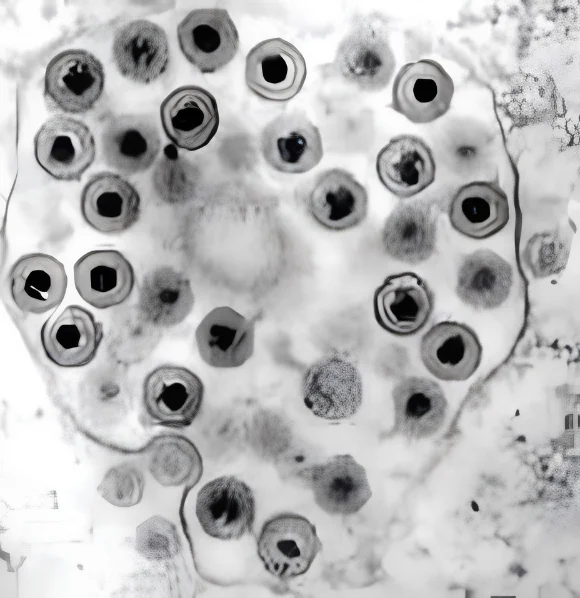
Not long after that, her postdoc found herpes inside the amyloid plaques in human brains.
Ruth Itzhaki: He's very, a very, very nice man and very cool, sort of, unemotional. And he came with his eyes actually gleaming. He said, come and have a look at this. And I remember going with him and seeing, you know, it really was marvelous to see that. And it, that 2009 paper was accepted fairly readily. I have to say that the only one that ever was, and, um, it got, you know, the press got very excited.
You know, anything which is slightly sensational is of course catnip for…
Elah Feder: it really looked to Ruth like herpes was somehow causing those telltale amyloid plaques to form. And all of this led her to propose something pretty radical. Maybe we can treat Alzheimer's disease with antivirals. Okay, actually testing this with a proper clinical trial, you'd need a lot of money and a lot of evidence. And for a long time, that didn't seem possible. But in 2018, Ruth got the next best thing, this very big retrospective study from Taiwan. They looked at the health insurance records of more than 33,000 people, and they found that those infected with herpes simplex were about two and a half times more likely to develop dementia.
They pulled out Alzheimer's specifically, too, and found, yep, infection more than doubled or almost tripled the rate of Alzheimer's.
But even more exciting, they found that people who took antiviral medicine for herpes had a dramatically lower risk of getting dementia, like 90% lower.
Katie Hafner: What?!
Elah Feder: Yeah. Uh, I'll temper that a little bit. A bunch of studies have since come out of other countries, and they also found that people who took antivirals, antiherpetics specifically, had a lower risk of dementia, but it wasn't as dramatic a reduction.
There, right? Like, Worth exploring.
Not only that, have you heard about this? If you get the shingles vaccine, as you might know, shingles is caused by another type of herpesvirus. That…
Katie Hafner: And you have to have had chickenpox in order to get shingles.
Elah Feder: Yes, it's the same virus. Yeah, it's like a reactivation, right? People get the shingles vaccine, also lower risk of dementia.
Katie Hafner: Amazing.
Elah Feder: Yeah, so when I read this, I got probably unjournalistically excited. I texted my friend who gets cold sores, and I told her to get that shingles vaccine, and get those antivirals
And then she has follow-up questions. She wants to know what dose, how long, what kind. I had no idea. I'd gotten totally ahead of myself because again, this is all correlational. so I mentioned this to Michael Heneka, a neurologist at the University of Luxembourg
Michael Heneka: It is interesting... it's 20, 25%, which is super strong.
Elah Feder: Here he's talking about the reduction of dementia risk in those shingle vaccine studies. And I was like, wait, wait, “but could you explain it away with, um, you know, people who are getting vaccines and antivirals have better healthcare, they're generally being better, you know, being taken care of better, so…”
Michael Heneka: No, no, no, no, no.
Elah Feder: I'd contacted Michael expecting him to be like open-minded, but throw a little cold water on all this, but here he was telling me not to discount the effect of the shingles vaccine.
Michael Heneka: At the end of the day, we do not know what is the executive mechanism, the stuff that really mediates the protection, but it remains a protection, and therefore it's super interesting.
Elah Feder: So Michael at this point might be more confident than I am. His research focuses on inflammation in the brain as a cause of neurodegeneration in diseases like Alzheimer's. So the idea is that our immune systems, you know, for whatever reason, go into overdrive and end up injuring our brains, which is an idea that's gained a lot of traction in recent years.
Michael Heneka: I started to speak about immune systems in the brain in 95, '96, and I was always happy not to be beaten up by my colleagues physically because every- everything was tau and A beta, no one had an interest. That has changed a lot. I think it's now overall and by the entire field accepted that immune processes play an important role.
Elah Feder: One source of immune response is viruses, right, it could be viruses? So Michael doesn’t necessarily think that viruses are the main cause of Alzheimer's, but they could be part of why some patients get inflammation, or maybe they could be part of what accelerates an inflammatory process that's already happening there for another reason. But he was open to it as a contributing factor, at least in some cases.
So I should note that Michael does have some industry relationships. For example, he's on the advisory board of MunA, which is a company that's developing drugs meant to reduce neuroinflammation. Michael noted a few other ties, which we’ll put on the website. These kinds of relationships are very common in medical research. Though, maybe not so much for Ruth. When I asked her about her industry ties, she wrote back that she has no ties with any company. Though, you know, she obviously did receive small grants from companies in the past.
So Overall, looking at all this research that's come out in the past few years, Ruth does feel pretty vindicated. But interestingly, one thing she is not saying is that this proves her right and the amyloid hypothesis wrong. She actually never meant for her idea to be a rebuttal.
Ruth Itzhaki: But the amyloid people certainly got up in arms about this because they thought it was challenging. Why they said that, I don't know 'cause I never mentioned, as a, as an obstacle to the amyloid hypothesis. Never ever said a word about that. So it's their interpretation.
Elah Feder: Charles Piller, on the other hand, he's been openly critical of the amyloid hypothesis. His book that came out last year, Doctored, it looks at the state of Alzheimer's research. And a wow, did he find some disturbing stuff. It all started when Charles connected with a researcher at Vanderbilt University who found evidence of image manipulation in, in some papers on a potential Alzheimer's drug. But by the end of the book, he is reporting that more than 500 papers have images that are flagged as suspicious. There have been retractions, resignations, notes of concern tacked onto articles. So that is a huge story for another day. But even if we set aside those papers, and many Alzheimer's studies do still stand untarnished, Charles sees flaws in the basic amyloid hypothesis itself. Like he notes, for example…
Charles Piller: A lot of people die with heads full of amyloid and, to some degree, heads full of tau proteins, and they don't get Alzheimer's disease.
Elah Feder: If you look at cognitively normal people in their 70s, about a quarter to a third have amyloid buildup, but they're fine.
Katie Hafner: Wow.
Elah Feder: And the current approach to Alzheimer's hasn't exactly yielded big wins.
Since the '90s, a series of drugs have been developed that are designed to remove amyloid plaques.
Charles Piller: But then they found in clinical trials that time after time after time, these drugs and the vaccine failed to help people either regain cognitive abilities or even arrest the decline associated with Alzheimer's disease.
Elah Feder: Earlier this year, the Cochrane Collaboration, which is an independent body that reviews health and, and medical literature. It published a review that absolutely pans these drugs. Their conclusion, just flatly, was anti-amyloid drugs have no clinically meaningful effect.
Dennis Selkoe and some others have published a response to this review.
Dennis Selkoe: It did an incredibly stupid thing. It lumped together, uh, trials in Alzheimer's disease of completely different agents, most of which failed, did not work, and the trials had been reported individually and didn't work. and they lumped those with the only two trials that have really worked.
Elah Feder: Basically, Dennis told me that they took a bunch of drugs that didn't work, but then tarred with the same brush two new drugs that do work: lecanemab and donanemab.These are the only two, quote, "disease-modifying drugs currently approved by the FDA." Which means these drugs are believed to actually affect the course of Alzheimer's disease instead of just, you know, making people more comfortable.
Katie Hafner: Okay, that sounds promising
Elah Feder: it does sound promising. Let me tell you about one of these drugs: lecanemab.
In a clinical trial, they looked at the cognitive ability of patients. They used something called the CDRSB, but, the main thing you need to know is it, it looks at the actual cognitive performance, which is what we're interested in. On average, both groups, whether they got the drug or they got the placebo, they deteriorated a little bit over the course of the study.
But lecanemab, it appeared to slow down that deterioration a bit. At the end of the 18-month trial, the average difference between the treatment group and the placebo group was .45 points
Katie Hafner: Uh that, that doesn't sound like much
Elah Feder: It is a difference that is so small that it's actually below what's considered the threshold for clinically meaningful difference. As in, clinicians and family members would not be able to notice that anything was different. Now it is possible this gap would grow larger and more meaningful as patients take the drug for longer.
That's what some of the proponents argue, but TBD. So, while the FDA has approved this, not everyone is on board with lecanemab.
And I fell down a real rabbit hole with the arguments and counterarguments about this drug. Like, Katie, I spent days, weeks possibly.
Katie Hafner: Really?
Elah Feder: Yeah, I won't get too deep into it. Dennis pointed me to a subgroup of patients who seemed to fair especially well on this drug, but in the end my takeaway is that I need to see more patients on this drug for longer to know that it’s really making a meaningful difference.
So like Michael and others, I have to note that Dennis has previously disclosed some industry relationships. He's an ad hoc consultant for Eisai, which is one of the two companies responsible for commercializing lecanemab drugs. We’ll put more information on the website.
But for what it's worth, I do think that he's genuine here. I think he sincerely believes this drug offers something.
Dennis Selkoe: If my wife or I develop Alzheimer's, I'll want to be on lecanemab. There's no question. And if you brought your mother or a relative to me, I'd unequivocally say, if you have all the biomarkers and the indicators that you have true bona fide Alzheimer's, the only treatment available to you that has been proven to slow the disease, even though- though you say on average only a little, but that's okay, that's better than no slowing and just going into profound dementia.
Katie Hafner: What he's saying is that this is the best we've got.
Elah Feder: Yeah. If it is really the best we've got, I would take a chance on it, but it, it doesn't mean that I'm happy with what we've got, right?
And having reviewed all the evidence, I would say I'm at least as excited about the possible benefits of a shingles vaccine as I am about this.
Katie Hafner: Well, take the shingles vaccine anyway to prevent shingles, I mean, this is one of these cases where you're doing it for one reason.
Elah Feder: And hey, maybe there's an extra benefit, yeah.
Katie Hafner: All right, now that I've advocated for a shingles vaccine, where does all of this leave Ruth's research? So we have all these intriguing leads, but, uh, it sounds like there aren't any clear answers. Is that right?
Elah Feder: So remember Ruth's idea that if herpes is involved in Alzheimer's, maybe we should use an antiviral to treat it?
Katie Hafner: I remember that.
Elah Feder: So someone finally tested this very question. It was a team of researchers, some from Columbia, some NYU, some hospitals. They announced the results of the first ever double-blind randomized control study looking at antiviral treatment for Alzheimer's. Specifically, it was early Alzheimer's patients who also tested positive for herpes antibodies.
So they gave them a drug called valacyclovir. Normally, people would take this if they got an outbreak of cold sores or genital herpes or shingles. But they wanted to know, could this herpes drug treat Alzheimer's?
Katie Hafner: How did it go?
Elah Feder: It didn't work.
After 78 weeks, the researchers found no difference in amyloid or tau tangles, in brain shrinkage, and the treatment group actually had worse cognitive scores than the placebo, possibly because of the neurotoxic effects of the drug itself.
Ruth Itzhaki: That was extremely disappointing.
Elah Feder: Before the results came out, Ruth had written that this study built on years of her team's work, and yet she does not see this as a nail in the coffin.
Ruth Itzhaki: I have to say, it didn't work, but there's several very good reasons for that. Very good reasons.
Elah Feder: One thing she pointed out, and, an independent editorial also pointed out: maybe you need to take the antivirals earlier. Maybe once the process has started, you know, you've set off some kind of immune response, and it's too late for an antiviral to make a difference,
Or maybe the viruses were in a latent phase. Antivirals only work on active viruses.
Ruth Itzhaki: I've thought of a possible way around that, which I'm very excited about, and I'm hoping maybe to get some money to look into it.
I mean, it wouldn't solve the problem completely, but it would, it would elucidate a bit. Whether I'd get any money? I don't know. Probably not.
Katie Hafner: This is really breaking my heart. She just goes and goes and goes and tries and tries and tries.
Elah Feder: I feel like you have to have a pretty deep well of faith that you will be proven right in the end. I'm sure she would not call it faith, but she had to have really believed in this idea, you know, based on evidence, but more so than other people did. And she thinks that now, almost four decades since she started, people are finally starting to listen. Last year, she made Stat News' Status list of top life science influencers.
This year, she was elected to the Academia Europea, which is a very prestigious body.
Charles Piller: There's no question that her thinking has influenced the field and is leading to new ideas about the infectious possibilities behind Alzheimer's disease. And also, I think probably more important is that her ability to stick with it, her willingness to even sacrifice elements of her scientific success has given courage to other people who have different ideas that are, just, thoughts that need to be explored.
Katie Hafner: So Ella, Ruth has been at this for decades. Is she finally retiring?
Elah Feder: Well she is a professor emerita at the University of Manchester, but she's still at it. She is, uh, currently a visiting professorial fellow at the Oxford Institute of Population Aging. She is trying to get funding for another study.
Katie Hafner: Really? So she's a role model, and her story is not over. But at this point, I guess I have to wonder how would you say Ruth is gonna be remembered in the long term?
Might her thesis be proven correct and then it's huge news or…?
Elah Feder: I think that's what will ultimately determine how she gets remembered. You know, if she does get that little bit of money to test the idea and somehow does a, like a clinical trial that cures Alzheimer's, she's gonna be remembered.
So if in 20 years we're all getting herpes vaccines and Alzheimer's rates have dropped to, to nothing, I think Ruth will have a very powerful legacy.
On the other hand, if in 20 years we just have a pileup of more failed antiviral trials and then maybe some fancy new drug comes along that eliminates tau tangles and that cures Alzheimer's, I think that Ruth's work will be forgotten.
You know, we usually remember the people that clearly move science forward, or at least the ones who steal credit for it, which is why I love doing stories like this. You know, if we only remember the endpoints, the wins, we are missing what is actually happening in science, these very messy, confusing, frustrating midpoints.
Katie Hafner: Mm-hmm, yeah all the failures.
Elah Feder: At the same time, I do want answers. We need a cure. So I will cheer on whoever solves this problem and hope that they are remembered.
This episode was produced by me, Elah Feder, Natalia Sanchez Loayza is our senior managing producer. Our music was composed by Lizzy Younan. Kelly Hills was our fact checker, and we had additional fact checking help from Olivia Babyok. Shreya Prabhu was our intern.
Thanks to our co-executive producers, Amy Scharf and Katie Hafner, to Eowyn Burtner, our program manager, and to growth & development director, Lily Whear.
We are distributed by PRX. Our funding comes in part from the Alfred P. Sloan Foundation and the Anne Wojcicki Foundation. If you visit lostwomenofscience.org, you can find a lot of extra material for this episode plus a donate button.
We’ll see you next time!
Listen to the Next Episode in this Series
More Episodes
Listen to the complete collection of episodes in this series.
